
Uncle Jim’s Worm Castings – Free Shipping*

From: $22.95

  • Real, raw worm castings: dark, crumbly and a bit damp, screened right from our active worm beds
  • Never pasteurized: no heat-treating, so the natural soil life from our beds comes along
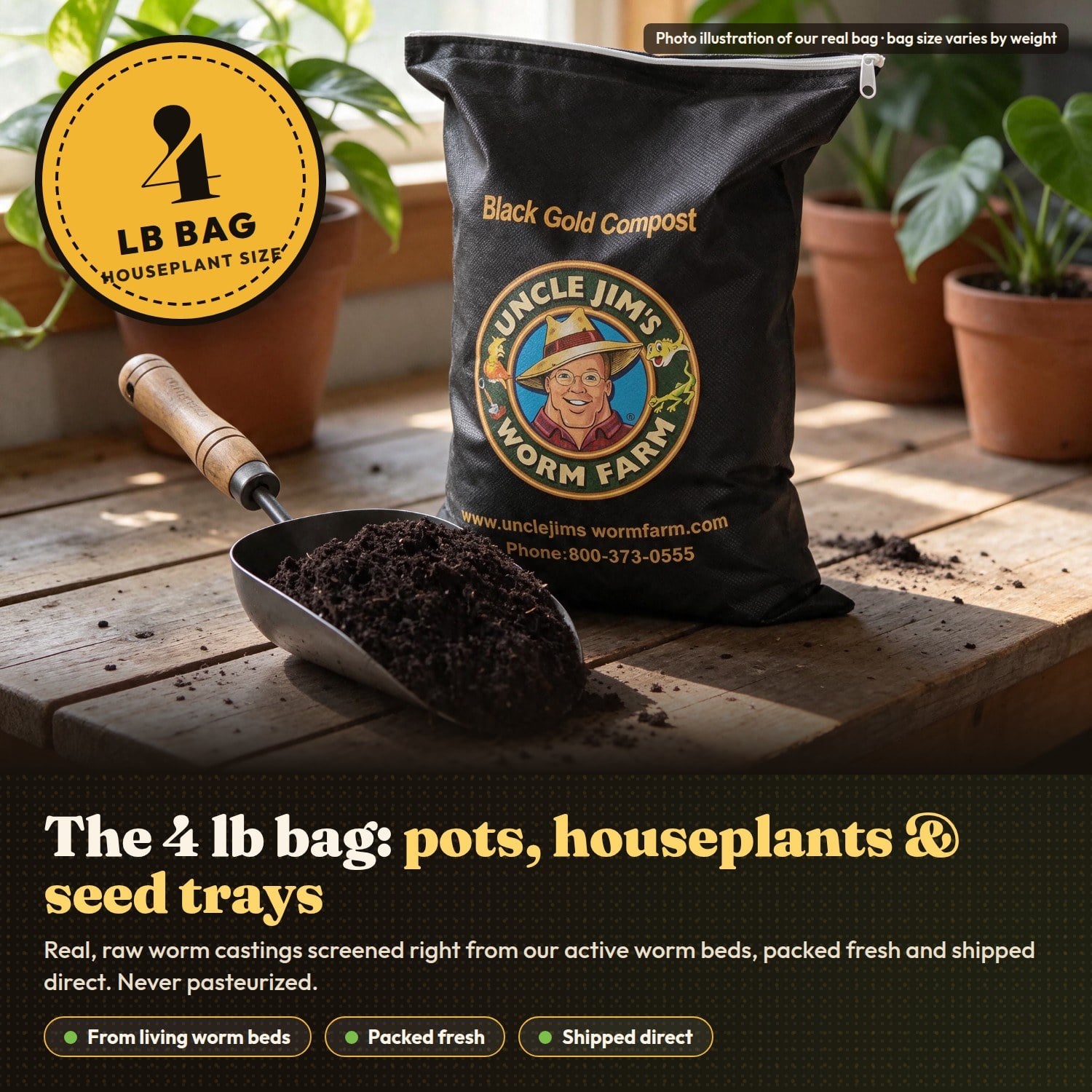
  • Not mass-made: made by our own composting worms, packed fresh and shipped direct from our worm farm
  • Easy to use: mix into potting soil, top-dress pots, work into beds or blend into seed-starting mix
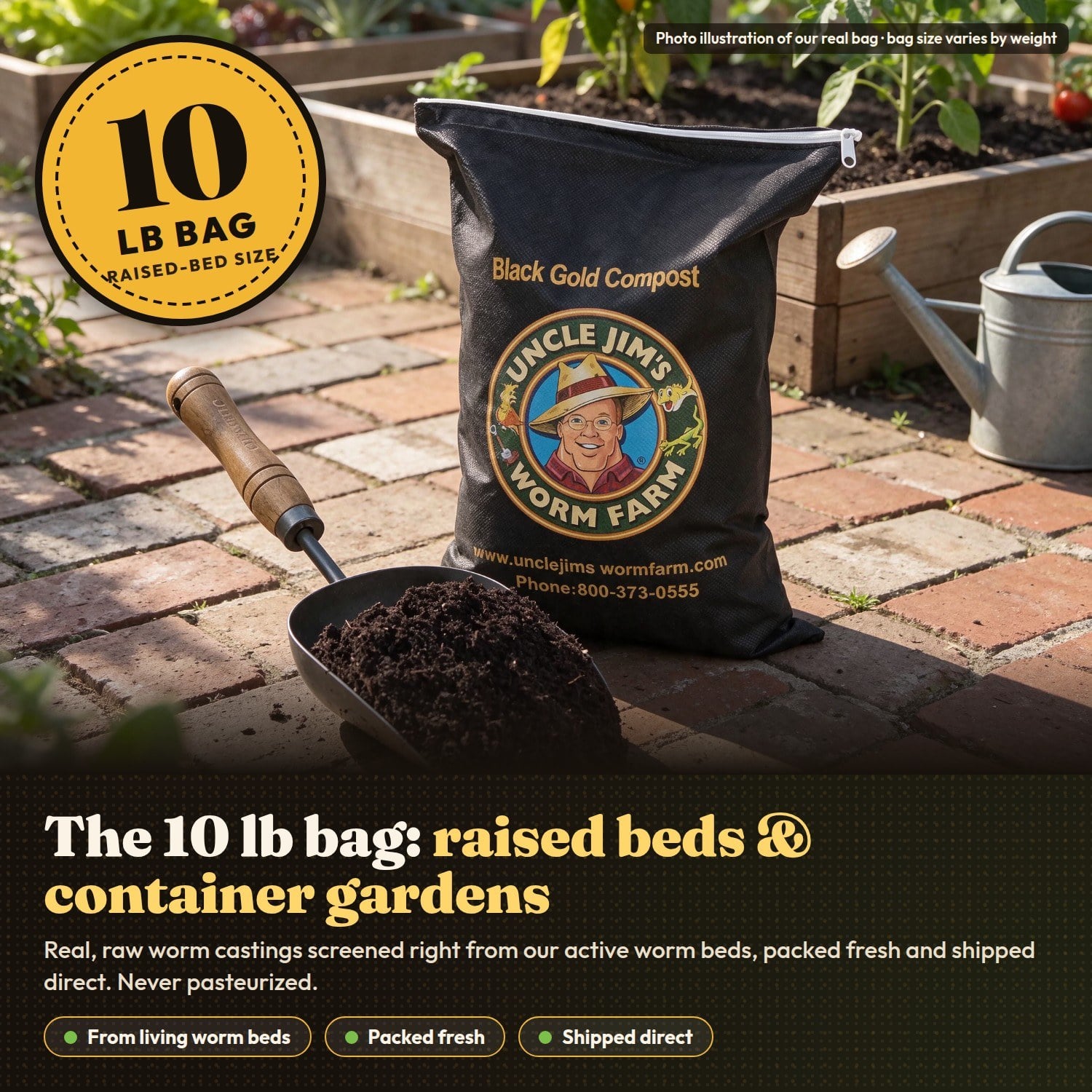
  • 4, 10 or 20 lb bags: bigger bags cost less per pound, and you can add our Classic Hand Scoop
  • Free shipping by FedEx or UPS: on every bag size; questions? Ask a real worm farmer at 800-373-0555

Carbon Steel, Chrome Surface, Rubber Wood Handle with TPR Grip. 15 inches.

SKU: 28844 Categories: ,

Description

Raw worm castings · Black Gold

The real stuff, straight from our worm beds.

Raw, never pasteurized worm castings, screened right from our active worm beds, packed fresh and shipped straight to you.

This is not a mass-made bag that sat in a warehouse. Our composting worms work through aged cow manure, spent grains, orange pulp and peat moss day after day, and what they leave behind is Black Gold: dark, crumbly, earthy castings. We scoop it, screen it, bag it and ship it. Mix it into potting soil, top-dress your houseplants or work it into the garden.

Raw
never pasteurized
Fresh
scooped from active beds
Free
FedEx or UPS shipping
  • Real worm castings from our own worm beds
  • Never heat-treated or pasteurized
  • Dark, crumbly and a bit damp, the way fresh castings should be
  • Pick a 4, 10 or 20 lb bag; bigger bags cost less per pound

Pick your bag size

Not sure which size? Call 800-373-0555 and talk to a real worm farmer.
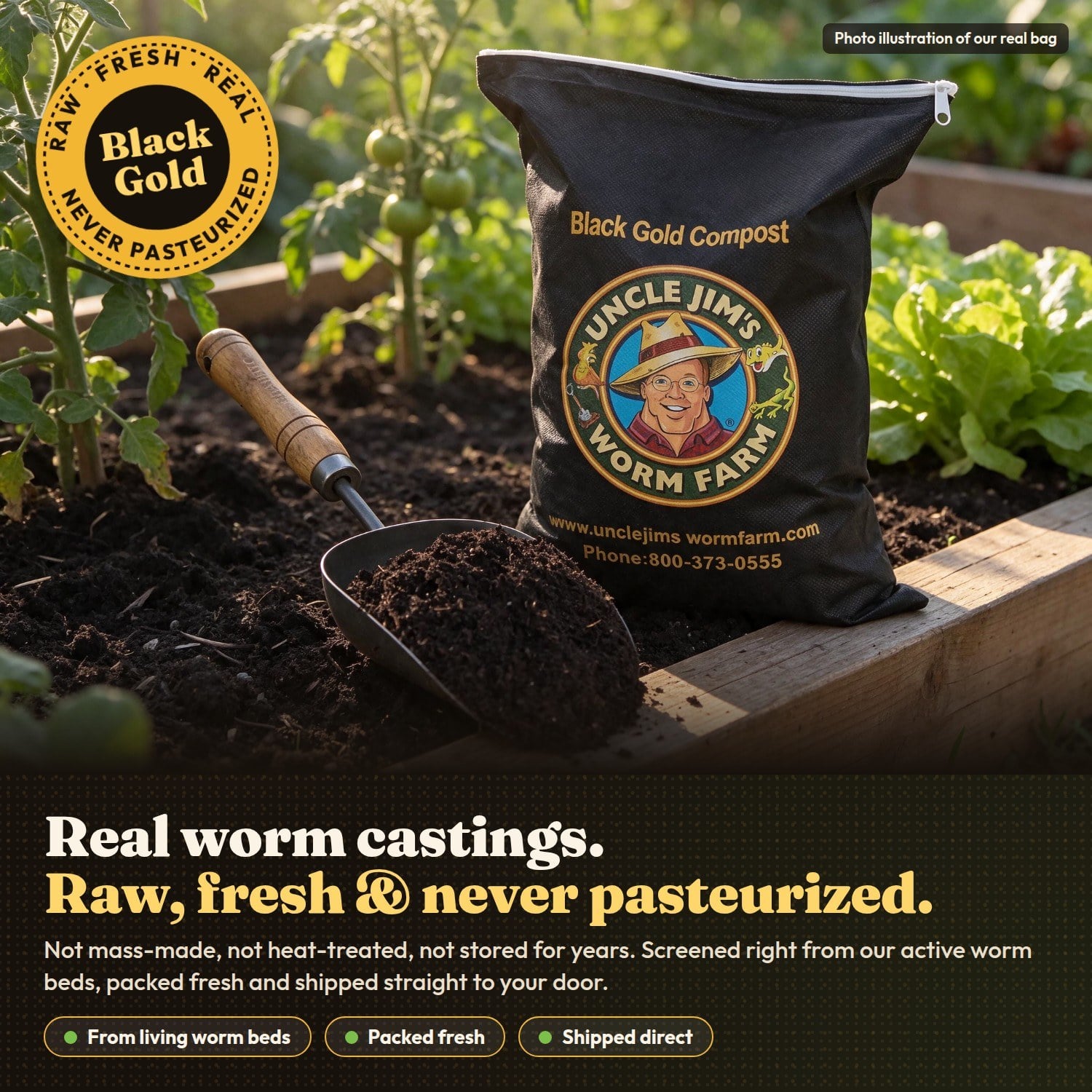
Uncle Jim's Worm Farm black zip bag of raw worm castings, Black Gold, with a metal scoop of dark castings in a garden bed
Photo illustration of our real bag.
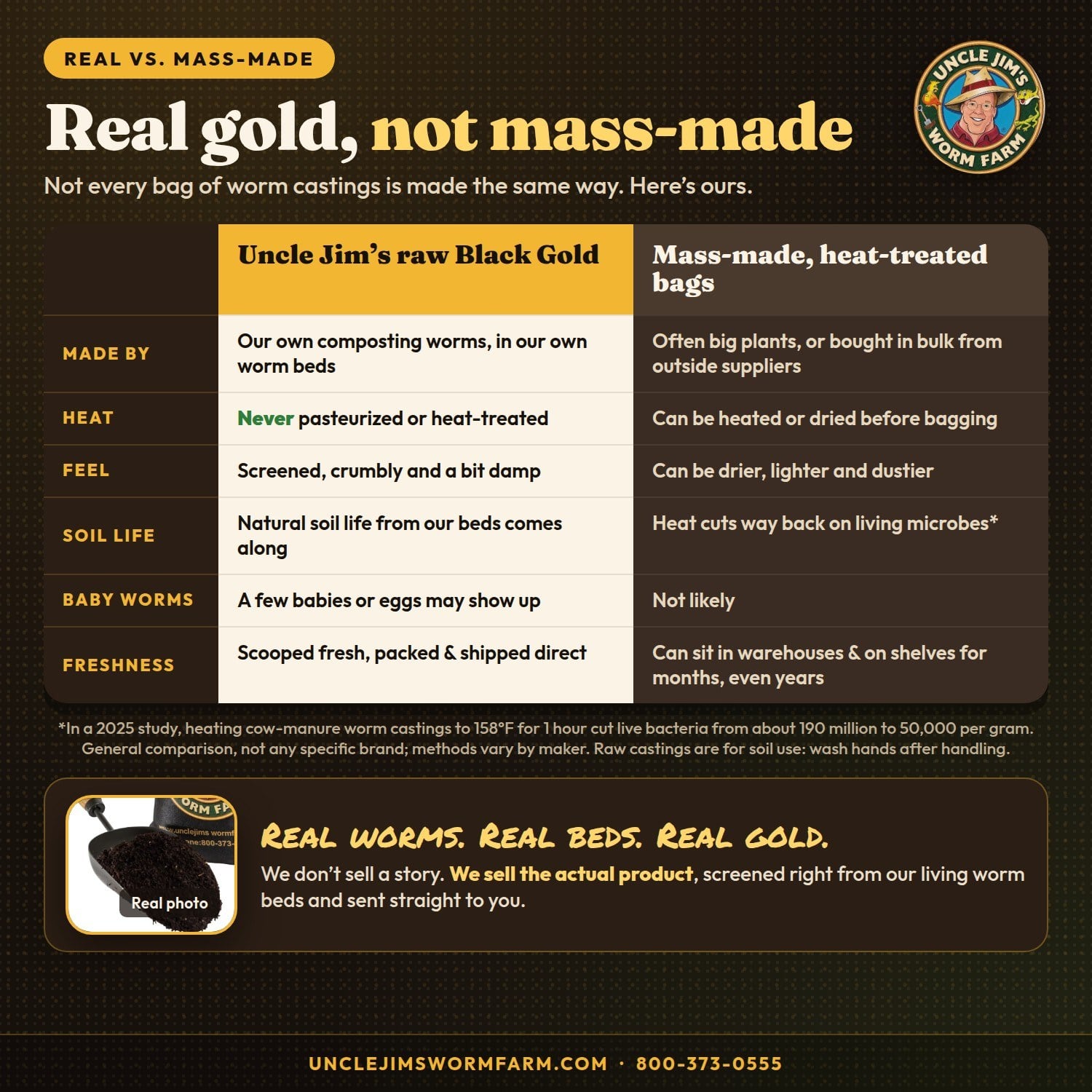
Chart comparing Uncle Jim's raw, never pasteurized worm castings with mass-made, heat-treated bagged castings
General comparison, not any specific brand. Original graphic.
Real vs. mass-made
Here is the honest difference

Not mass-made. Not heat-treated. Not stored for years.

Plenty of bagged castings come from big operations or bulk suppliers. Some are heated or dried before bagging, and a bag can sit in a warehouse or on a store shelf for months before it reaches your garden. Ours goes from our worm beds to a bag to your door.

Made by
Our own composting worms, in our own worm beds
Heat
None. Never pasteurized or heat-treated.
Feel
Screened, crumbly and a bit damp
Freshness
Scooped fresh, packed and shipped direct

Why heat matters: In a 2025 study, one hour at 158°F cut the live bacteria researchers could count in worm castings from about 190 million to 50,000 per gram. Seedlings still grew fine in the heated castings, so we will not knock anyone else’s bag. Ours is simply sent the way the worms made it.
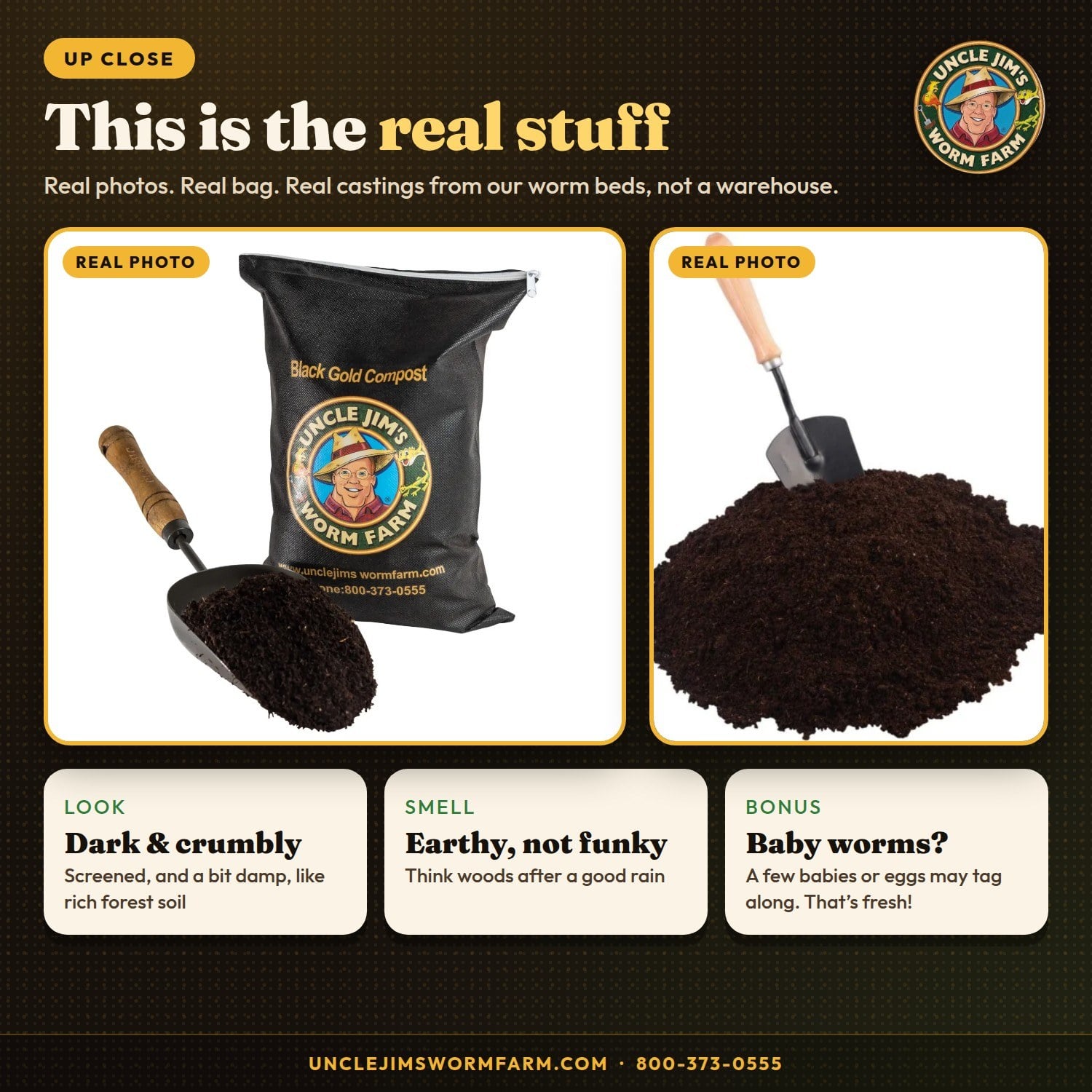
Real photos of Uncle Jim's Black Gold worm castings: the black zip bag with a full scoop and a crumbly pile with a trowel
Real photos of our bag and castings.
Up close

This is what real looks like.

No glossy stock shots here. These are our real bag and our real castings. Open the zipper and you will see dark, crumbly castings, feel a little moisture and smell the woods after a good rain.

Look

Dark and crumbly

Screened right from the beds, so it breaks apart easily in your hand.

Smell

Earthy, not funky

Oregon State Extension describes finished worm castings as earthy and fresh.

Bonus

A few hitchhikers

A baby worm or a tiny egg may tag along. That means fresh, not a flaw.

Real video from our worm farm.
Meet Jim

Straight out of our own pits.

Press play and meet Jim. He has been raising worms for over 50 years, and in this short video he shows you the real castings we scoop from our worm beds and bag for you.

“We are not the middleman. This comes right out of the pits right here on the farm.”

— Jim

“It might be a little chunky, there might be some weeds. Like I said, it’s real.”

— Jim

Jim’s one rule: mix it in. Never plant straight into castings alone.
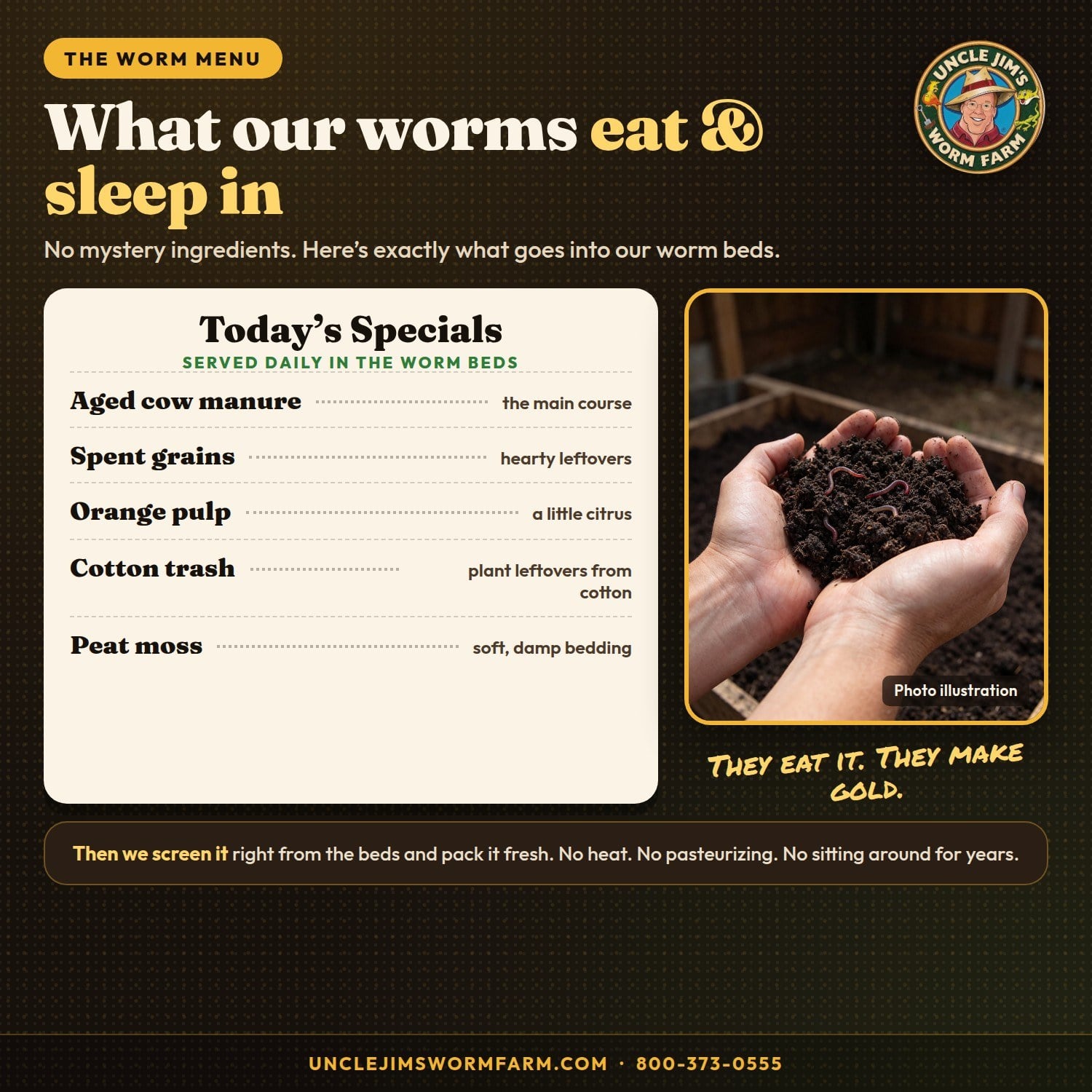
What our composting worms eat and live in: aged cow manure, spent grains, orange pulp, cotton gin leftovers and peat moss
Photo illustration.
The worm menu

No mystery ingredients.

You should know what made your castings. Here is exactly what goes into our worm beds.

Aged cow manure
The main course
Spent grains
Hearty grain leftovers
Orange pulp
A little citrus
Cotton trash
Plant leftovers from cotton processing
Peat moss
Soft, damp bedding

The worms eat it, we screen it, and that is the whole recipe. No heat, no pasteurizing and no sitting around for years.
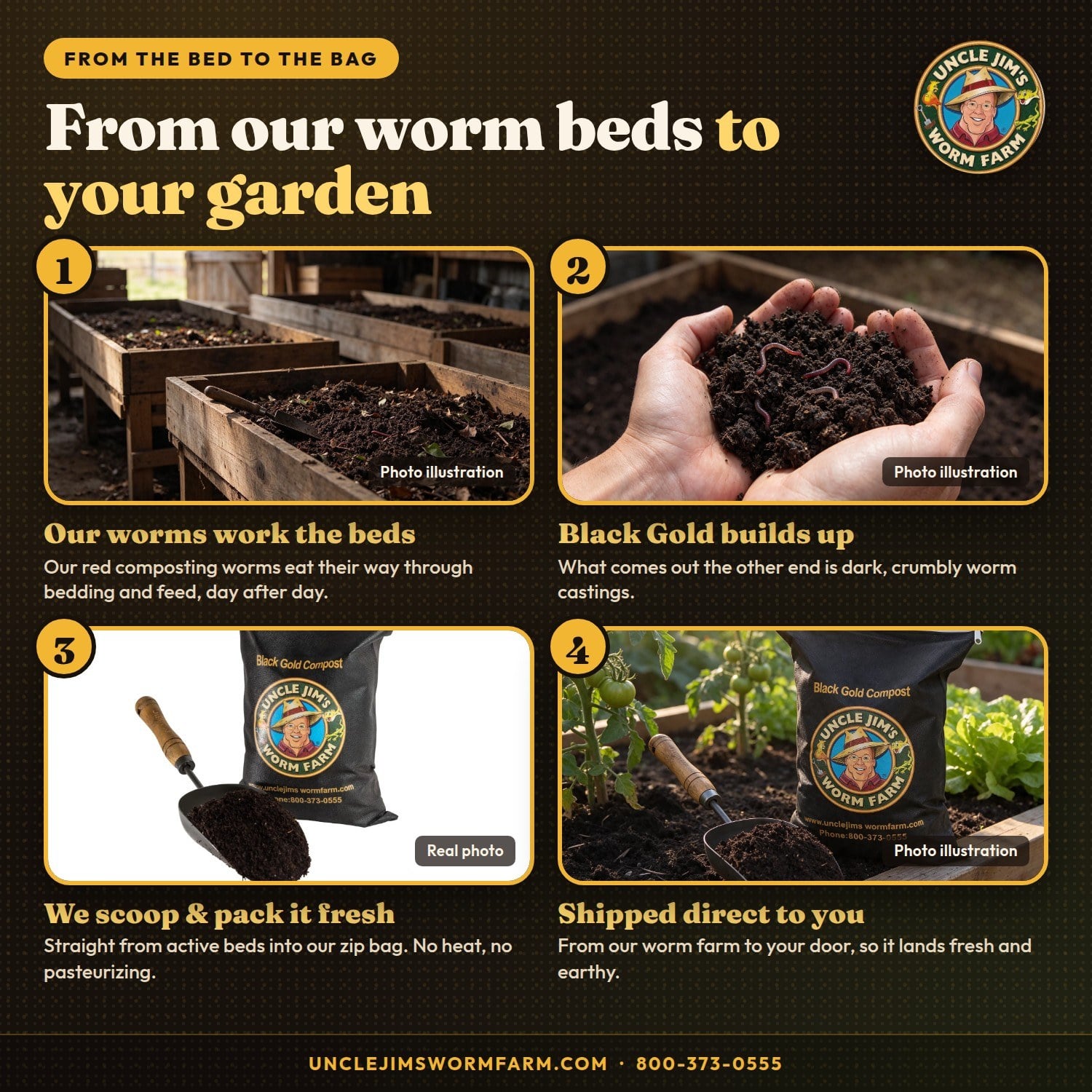
Four steps from our worm beds to your garden: worms work the beds, castings build up, we scoop and pack it fresh, and ship it direct
Step 3 is a real photo of our bag. The other steps are photo illustrations.
From the bed to the bag

Four steps. No shortcuts.

1

Our worms work the beds

Our red composting worms eat their way through bedding and feed, day after day.

2

Black Gold builds up

What they leave behind is dark, crumbly worm castings.

3

We scoop and pack it fresh

Screened right from active beds into our zip bag. No heat, no pasteurizing.

4

Shipped direct to you

Free FedEx or UPS shipping from our worm farm to your door.

Want worms of your own? Meet our Red Composting Worm Mix.
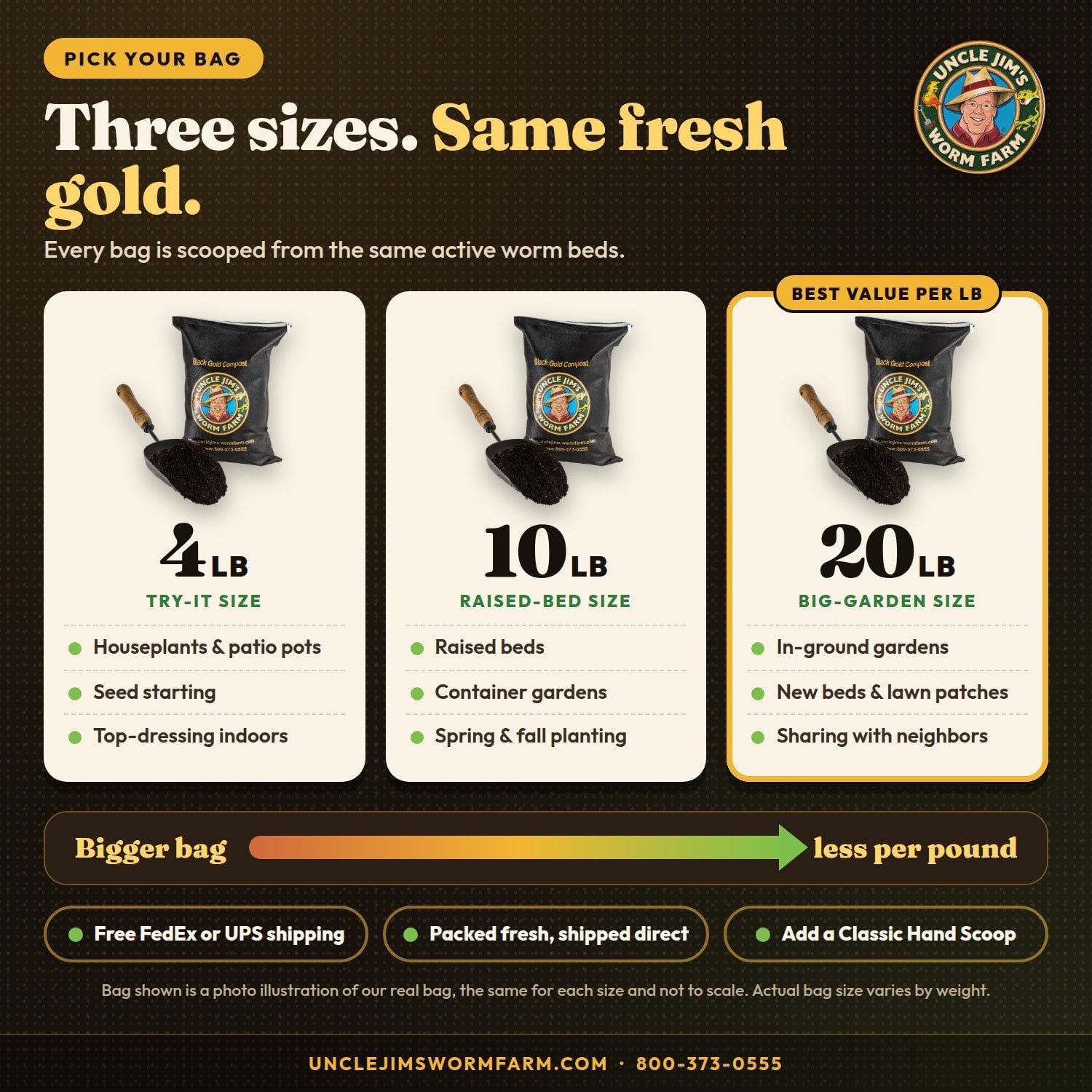
Uncle Jim's worm castings in 4 lb, 10 lb and 20 lb bags with what each size suits; the bigger bag costs less per pound
Bag shown is a photo illustration of our real bag, not to scale. Actual bag size varies by weight.
Pick your bag

Three sizes. Same fresh gold.

Every bag is scooped from the same active worm beds. Pick the size that fits your growing, then choose it in the size menu at the top of the page.

4
LB
Try-it size

Houseplants, patio pots, seed starting and top-dressing indoors.

10
LB
Raised-bed size

Raised beds, container gardens and spring or fall planting.

20
LB
Big-garden sizeLeast per pound

In-ground gardens, new beds, lawn patches and sharing with the neighbors.

Add a scoop: Check “Add a Classic Hand Scoop” before you add to cart for a 15 inch carbon steel scoop with a chrome finish and a rubber wood handle with a soft grip.
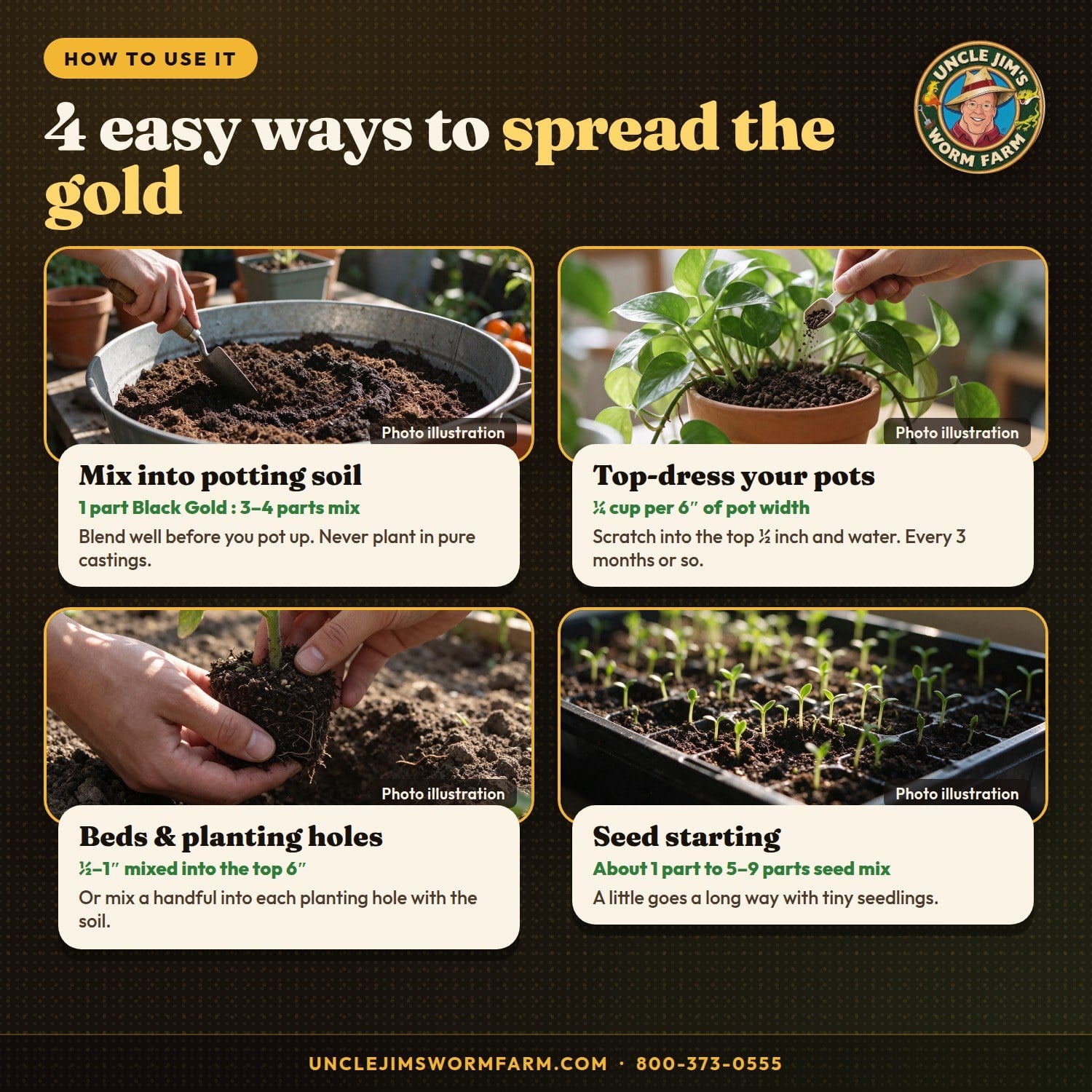
Four ways to use worm castings: mix into potting soil, top-dress pots, work into beds and planting holes, and blend into seed-starting mix
Photo illustrations.
How to use it

4 easy ways to spread the gold.

Black Gold is easy. The one rule: mix it in or sprinkle it on, but do not plant straight into castings alone.

1

Mix into potting soil

About 1 part castings to 3 or 4 parts mix. Oregon State suggests up to 25%, and Oklahoma State says a quarter to a third.

2

Top-dress your pots

About ¼ cup for every 6 inches of pot width. Scratch it into the top ½ inch and water.

3

Beds and planting holes

Work ½ to 1 inch into the top 6 inches of soil, or mix a handful into each planting hole.

4

Seed starting

Blend about 1 part castings into 5 to 9 parts seed-starting mix.
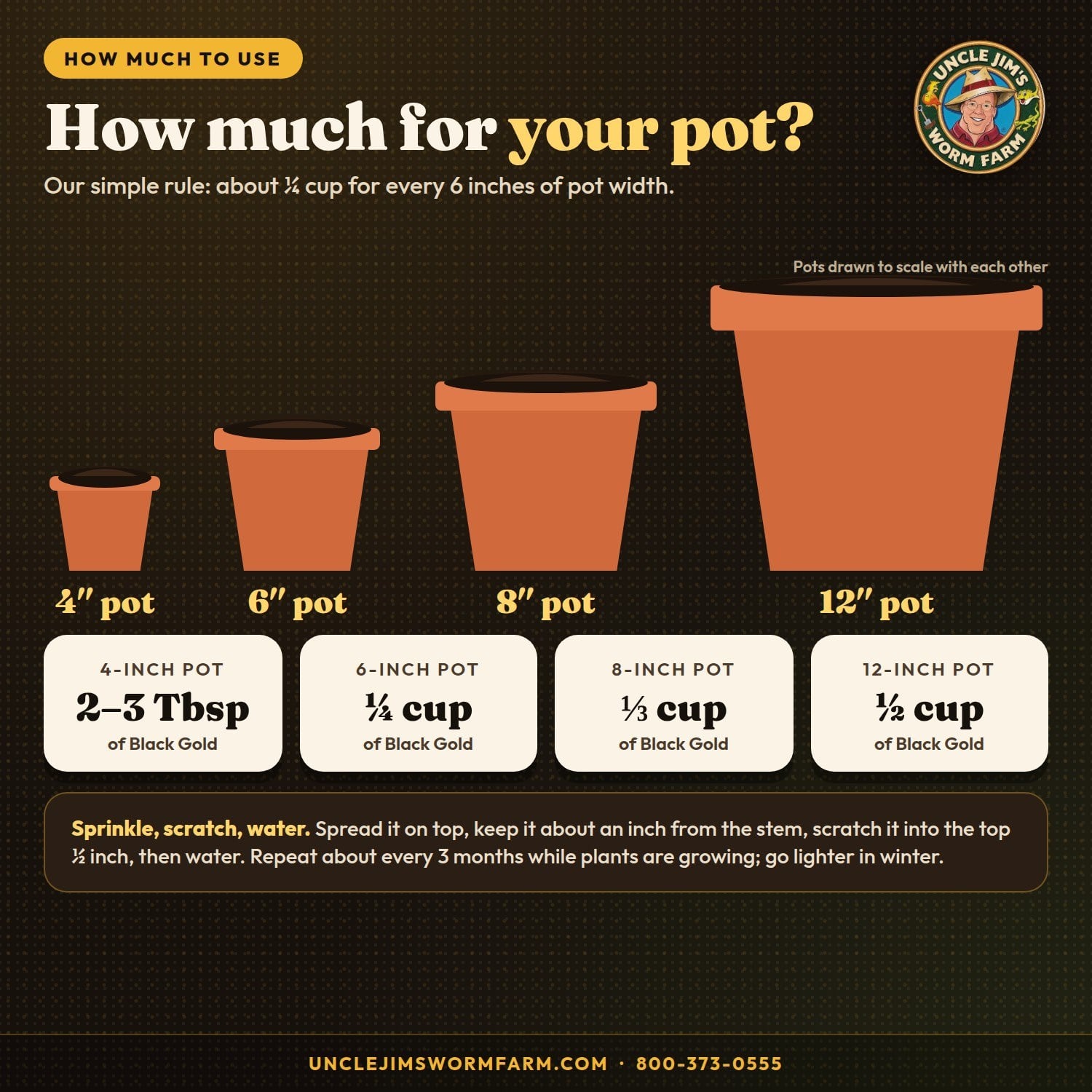
How much worm castings to top-dress a pot: 2 to 3 tablespoons for 4 inch, 1/4 cup for 6 inch, 1/3 cup for 8 inch, 1/2 cup for 12 inch
Pots drawn to scale with each other. Original graphic.
How much to use

The quarter-cup rule.

For houseplants and patio pots, our simple rule is about ¼ cup for every 6 inches of pot width.

4 inch pot
2 to 3 tablespoons
6 inch pot
¼ cup
8 inch pot
About ⅓ cup
12 inch pot
About ½ cup

Repeat about every 3 months while plants are growing and go lighter in winter. More tips in our worm castings for indoor plants guide.

Worm castings used on houseplants, vegetable beds, seedlings, roses, herbs and lawn patches
Photo illustrations.
Who loves it

Everything that grows in dirt.

Indoors or out, a little Black Gold goes a long way.

HouseplantsVeggie bedsSeedlingsRoses and flowersHerbsLawn patches

Growing food? Read the garden-smart tips in the next section.
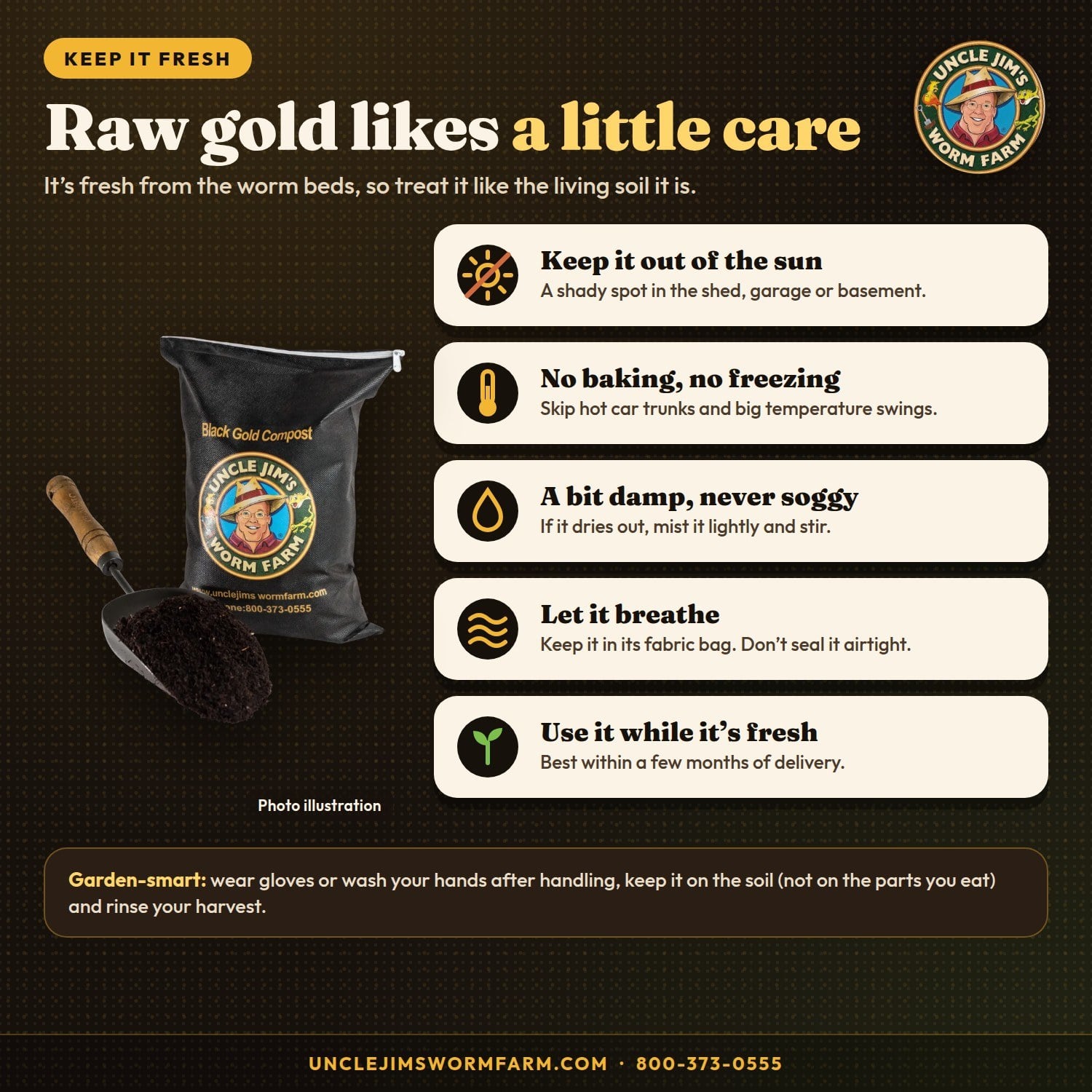
How to store raw worm castings: out of the sun, no baking or freezing, a bit damp, let it breathe, and use it while fresh
Photo illustration of our real bag.
Keep it fresh

Raw gold likes a little care.

It is fresh from the worm beds, so treat it like living soil, not a sack of dust.

  • A shady spot like a shed, garage or basement
  • No baking in a hot car and no freezing
  • A bit damp, never soggy; if it dries out, mist it lightly and stir
  • Let it breathe in its fabric bag; do not seal it airtight
  • Use it within a few months for the freshest gold

LSU AgCenter says properly stored castings last up to six months or more.

Garden-smart: Our castings are raw and our worms eat aged cow manure, so handle it like any manure-based soil amendment. Wear gloves or wash your hands after, keep it on the soil and off the parts you eat, and rinse your harvest. Oklahoma State’s careful rule is to apply it at least 90 days before harvest for crops that grow above the soil and 120 days for crops that touch it. More from Penn State Extension.
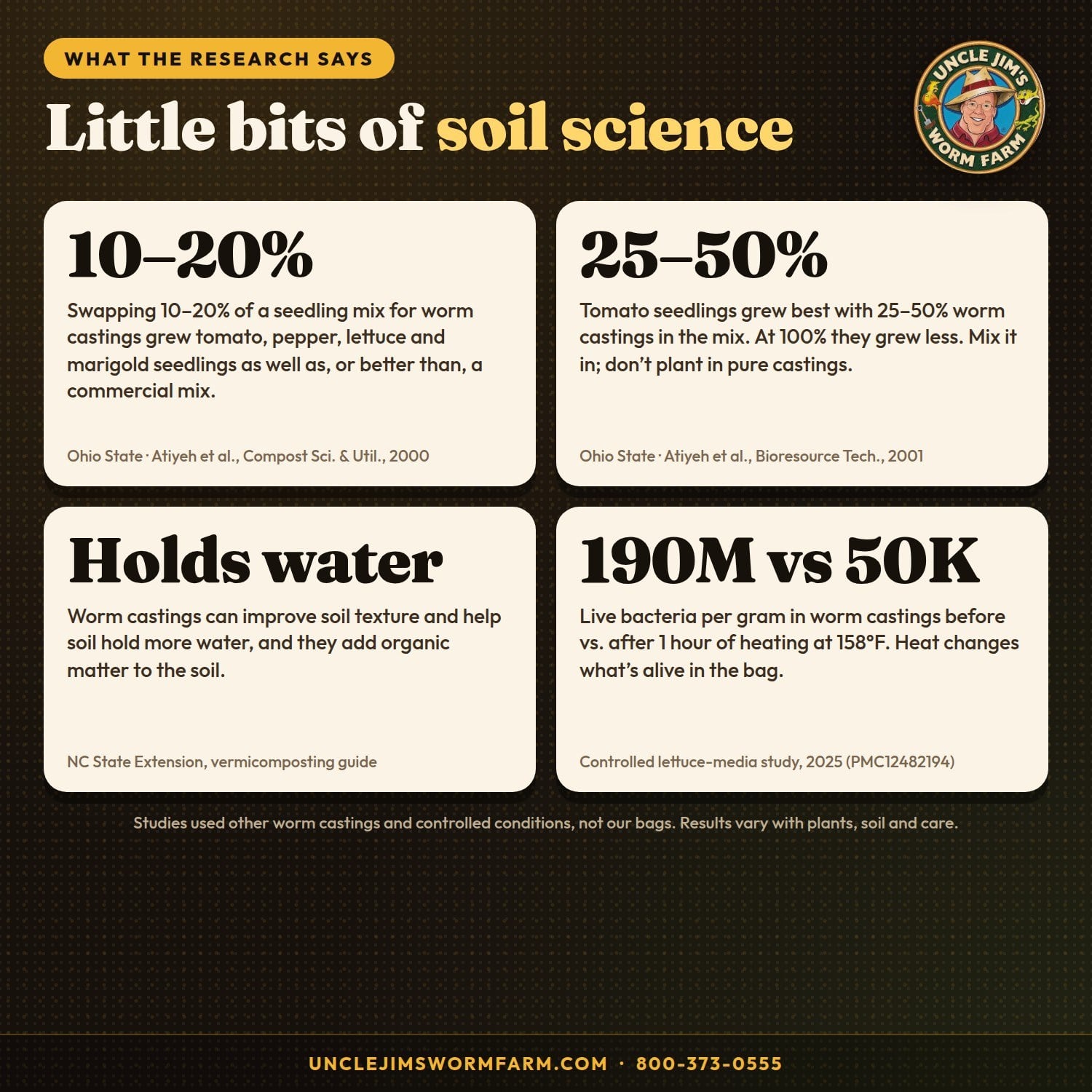
Worm castings research facts from Ohio State, NC State and a 2025 study on heat-treated castings
Original graphic with cited sources.
What the research says

Little bits of soil science.

We like to keep it honest, so here is what university research says about worm castings in general.

10 to 20%
Swapping 10 to 20% of a seedling mix for worm castings grew tomato, pepper, lettuce and marigold seedlings as well as, or better than, a commercial mix (Ohio State, 2000).
25 to 50%
Tomato seedlings grew best with 25 to 50% castings in the mix and grew less in castings alone (Ohio State, 2001).
Holds water
Worm castings can improve soil texture, help soil hold water and add organic matter (NC State Extension).
Heat matters
One hour at 158°F cut the live bacteria count in worm castings from about 190 million to 50,000 per gram (2025 study).

These studies used other worm castings under controlled conditions, not our bags. Results vary with plants, soil and care.

Questions

Raw worm castings FAQ

Straight answers about Black Gold, from the folks who scoop it.
What exactly is Black Gold?+

Black Gold is our name for worm castings: what is left behind after composting worms eat their way through their food and bedding. You will also hear it called worm compost or vermicompost. Ours is screened right from our active worm beds, so you get dark, crumbly, earthy castings that go straight into the bag and out the door.

What does “raw” and “never pasteurized” mean?+

It means we do not heat it. Some makers heat or dry their castings before bagging. In a 2025 study, heating cow-manure worm castings to 158°F for one hour cut the live bacteria researchers could count from about 190 million to 50,000 per gram. To be fair, seedlings in that study still grew fine in the heated castings, so heat is not “bad.” It just changes what is alive in the bag. We would rather send it to you the way the worms made it.

How is this different from the worm castings at the big-box store?+

Plenty of bagged castings are made at a big scale or bought in bulk from outside suppliers. Some are heated or dried before bagging, and a bag can sit in a warehouse or on a store shelf for months before anyone opens it. Ours is scooped from our own worm beds, packed fresh and shipped straight to you. Methods vary a lot from maker to maker, so it is always worth reading the bag of any brand you compare.

What do your worms eat?+

Aged cow manure, spent grains, orange pulp and cotton trash (the plant leftovers from cotton processing), with peat moss as soft, damp bedding. That is the whole menu. No mystery ingredients, and nothing added after we screen it.

Why is it a little chunky, and can a weed pop up?+

Because it is real and never heated. We screen it right from our worm beds, so it is mostly fine and crumbly, but a few soft clumps can slip through. Just crumble them between your fingers. Hot composting uses heat to stop weed seeds, and ours is never heated, so once in a while a weed seed can come along and sprout. Pull it like any other weed. That is the trade for castings that come to you the way the worms made them.

Why are there baby worms or tiny eggs in my castings?+

Because it is fresh. It comes straight from active worm beds, so a few baby worms or tiny lemon-shaped worm eggs can tag along. Outdoors, they are happy in garden beds, compost piles or a worm bin. Please do not dump them in the woods or near streams; Great Lakes Worm Watch asks gardeners not to. For indoor pots, if you would rather have zero hitchhikers, Penn State Extension suggests freezing castings for 1 to 4 weeks before use. That is the one time we would say freeze it.

Why are the castings damp?+

Fresh castings are supposed to be a bit damp. LSU AgCenter describes good castings as crumbly and slightly damp, and says to keep them out of the sun and away from big temperature swings. Damp is normal. Soggy or dripping is not, so if a bag ever arrives soaked, call us at 800-373-0555.

Do worm castings smell?+

They should smell earthy, like the woods after a good rain. Oregon State Extension says finished worm castings smell earthy and fresh. A strong sour or rotten smell is not normal. If you ever open a bag and get that, call us at 800-373-0555.

How much should I use on houseplants and pots?+

Our rule of thumb is about ¼ cup for every 6 inches of pot width: 2 to 3 tablespoons for a 4 inch pot, ¼ cup for a 6 inch pot, about ⅓ cup for an 8 inch pot and about ½ cup for a 12 inch pot. Spread it on top about an inch from the stem, scratch it into the top ½ inch and water. Repeat about every 3 months while plants are growing and go lighter in winter. There are more tips in our worm castings for indoor plants guide.

How do I mix worm castings into potting soil or seed-starting mix?+

For potting soil, use about 1 part castings to 3 or 4 parts mix. Oregon State Extension suggests up to 25% castings, and Oklahoma State Extension says a quarter to a third. For seed starting, go lighter: about 10 to 20%. In an Ohio State study, that much worm castings in a seedling mix grew tomato, pepper, lettuce and marigold seedlings as well as, or better than, a commercial mix. Do not pot plants in castings alone; tomato seedlings in another Ohio State study grew less in straight castings.

How do I use it in garden beds and planting holes?+

Work ½ to 1 inch of castings into the top 6 inches of soil, which is the rate Oklahoma State Extension gives. For new plants, mix a handful into each planting hole with the soil you dug out. For plants already in the ground, scratch a little in around the base and water.

Can I use raw worm castings in my vegetable garden?+

Yes, with a few garden-smart habits. Our castings are raw and our worms eat aged cow manure, so handle it like any manure-based soil amendment. Wear gloves or wash your hands after, keep it on the soil and off the parts you eat, and rinse your harvest. Oklahoma State gives a careful rule: apply worm castings at least 90 days before harvest for crops that grow above the soil and 120 days for crops that touch it, like lettuce, carrots and strawberries. The easy way is to work it into your beds when you prep them. More tips from Penn State Extension.

Will worm castings bring fungus gnats into my houseplants?+

Fungus gnats lay their eggs in moist potting soil and organic matter (UC IPM), so any rich, damp soil amendment can give them a spot. Indoors, use a modest amount, use pots with drainage holes, empty standing water from saucers and let the top of the soil dry between waterings. Yellow sticky cards are an easy way to catch any adults.

How should I store my bag, and how long does it keep?+

Keep it in a shady spot like a shed, garage or basement, away from sun, heat and freezing. Keep it a bit damp; if it dries out, mist it lightly and stir. Leave it in its fabric bag and do not seal it airtight. LSU AgCenter says properly stored castings last up to six months or more, but this is fresh stuff, so we say use it within a few months for the freshest gold.

Is Black Gold a fertilizer?+

Think of it as a soil amendment, not a fertilizer. We have not had it lab tested, so we do not list fertilizer numbers. What worm castings do is add organic matter and help improve soil texture and how well soil holds water (NC State Extension). Keep your usual plant feeding routine and use Black Gold alongside it.

How does shipping work, and what if there is a problem?+

Every size ships free by FedEx or UPS, straight from our worm farm. Open the box when it lands and give it a sniff. If anything looks wrong, like a torn or soaked bag, a sour smell or something growing on top you are not sure about, snap a photo and call us at 800-373-0555 or email sales@unclejimswormfarm.com, 10 AM to 6 PM Eastern. We will help.

Free shipping

FedEx or UPS, on every bag size.

From active beds

Scooped from our worm beds and packed fresh.

Real people

Call 800-373-0555, 10 AM to 6 PM Eastern.

Problem with a bag?

Call or email sales@unclejimswormfarm.com and we will help.

Ready to dig in?

Give your garden the real stuff.

Raw, never pasteurized worm castings, screened from our active worm beds and shipped free by FedEx or UPS. Pick 4, 10 or 20 lb at the top of the page.

Choose your bag

Bigger bags cost less per pound. Add the Classic Hand Scoop if you like.

Uncle Jim's 20 lb bag of raw worm castings in a garden wheelbarrow next to big in-ground vegetable beds

Additional information

Weight 1 lbs
Weight

4 Pound Bag of Gold, 10 Pound Bag of Gold, 20 Pound Bag of Gold

Uncle Jim’s Raw Worm Castings (Black Gold): Frequently Asked Questions

What exactly is Black Gold?

Black Gold is our name for worm castings: what is left behind after composting worms eat their way through their food and bedding. You will also hear it called worm compost or vermicompost. Ours is screened right from our active worm beds, so you get dark, crumbly, earthy castings that go straight into the bag and out the door.

What does “raw” and “never pasteurized” mean?

It means we do not heat it. Some makers heat or dry their castings before bagging. In a 2025 study, heating cow-manure worm castings to 158°F for one hour cut the live bacteria researchers could count from about 190 million to 50,000 per gram. To be fair, seedlings in that study still grew fine in the heated castings, so heat is not “bad.” It just changes what is alive in the bag. We would rather send it to you the way the worms made it.

How is this different from the worm castings at the big-box store?

Plenty of bagged castings are made at a big scale or bought in bulk from outside suppliers. Some are heated or dried before bagging, and a bag can sit in a warehouse or on a store shelf for months before anyone opens it. Ours is scooped from our own worm beds, packed fresh and shipped straight to you. Methods vary a lot from maker to maker, so it is always worth reading the bag of any brand you compare.

What do your worms eat?

Aged cow manure, spent grains, orange pulp and cotton trash (the plant leftovers from cotton processing), with peat moss as soft, damp bedding. That is the whole menu. No mystery ingredients, and nothing added after we screen it.

Why are there baby worms or tiny eggs in my castings?

Because it is fresh. It comes straight from active worm beds, so a few baby worms or tiny lemon-shaped worm eggs can tag along. Outdoors, they are happy in garden beds, compost piles or a worm bin. Please do not dump them in the woods or near streams; Great Lakes Worm Watch asks gardeners not to. For indoor pots, if you would rather have zero hitchhikers, Penn State Extension suggests freezing castings for 1 to 4 weeks before use. That is the one time we would say freeze it.

Why are the castings damp?

Fresh castings are supposed to be a bit damp. LSU AgCenter describes good castings as crumbly and slightly damp, and says to keep them out of the sun and away from big temperature swings. Damp is normal. Soggy or dripping is not, so if a bag ever arrives soaked, call us at 800-373-0555.

Do worm castings smell?

They should smell earthy, like the woods after a good rain. Oregon State Extension says finished worm castings smell earthy and fresh. A strong sour or rotten smell is not normal. If you ever open a bag and get that, call us at 800-373-0555.

How much should I use on houseplants and pots?

Our rule of thumb is about ¼ cup for every 6 inches of pot width: 2 to 3 tablespoons for a 4 inch pot, ¼ cup for a 6 inch pot, about ⅓ cup for an 8 inch pot and about ½ cup for a 12 inch pot. Spread it on top about an inch from the stem, scratch it into the top ½ inch and water. Repeat about every 3 months while plants are growing and go lighter in winter. There are more tips in our worm castings for indoor plants guide.

How do I mix worm castings into potting soil or seed-starting mix?

For potting soil, use about 1 part castings to 3 or 4 parts mix. Oregon State Extension suggests up to 25% castings, and Oklahoma State Extension says a quarter to a third. For seed starting, go lighter: about 10 to 20%. In an Ohio State study, that much worm castings in a seedling mix grew tomato, pepper, lettuce and marigold seedlings as well as, or better than, a commercial mix. Do not pot plants in castings alone; tomato seedlings in another Ohio State study grew less in straight castings.

How do I use it in garden beds and planting holes?

Work ½ to 1 inch of castings into the top 6 inches of soil, which is the rate Oklahoma State Extension gives. For new plants, mix a handful into each planting hole with the soil you dug out. For plants already in the ground, scratch a little in around the base and water.

Can I use raw worm castings in my vegetable garden?

Yes, with a few garden-smart habits. Our castings are raw and our worms eat aged cow manure, so handle it like any manure-based soil amendment. Wear gloves or wash your hands after, keep it on the soil and off the parts you eat, and rinse your harvest. Oklahoma State gives a careful rule: apply worm castings at least 90 days before harvest for crops that grow above the soil and 120 days for crops that touch it, like lettuce, carrots and strawberries. The easy way is to work it into your beds when you prep them. More tips from Penn State Extension.

Will worm castings bring fungus gnats into my houseplants?

Fungus gnats lay their eggs in moist potting soil and organic matter (UC IPM), so any rich, damp soil amendment can give them a spot. Indoors, use a modest amount, use pots with drainage holes, empty standing water from saucers and let the top of the soil dry between waterings. Yellow sticky cards are an easy way to catch any adults.

How should I store my bag, and how long does it keep?

Keep it in a shady spot like a shed, garage or basement, away from sun, heat and freezing. Keep it a bit damp; if it dries out, mist it lightly and stir. Leave it in its fabric bag and do not seal it airtight. LSU AgCenter says properly stored castings last up to six months or more, but this is fresh stuff, so we say use it within a few months for the freshest gold.

Is Black Gold a fertilizer?

Think of it as a soil amendment, not a fertilizer. We have not had it lab tested, so we do not list fertilizer numbers. What worm castings do is add organic matter and help improve soil texture and how well soil holds water (NC State Extension). Keep your usual plant feeding routine and use Black Gold alongside it.

How does shipping work, and what if there is a problem?

Every size ships free by FedEx or UPS, straight from our worm farm. Open the box when it lands and give it a sniff. If anything looks wrong, like a torn or soaked bag, a sour smell or something growing on top you are not sure about, snap a photo and call us at 800-373-0555 or email sales@unclejimswormfarm.com, 10 AM to 6 PM Eastern. We will help.

Can I use worm castings on my lawn?

Yes. NC State Extension lists a light sprinkle of worm castings as a lawn conditioner. Rake a thin layer over thin or bare patches, or mix some into the soil before you seed, then water it in. For lawn work, the 20 lb bag costs the least per pound.

Can worm castings burn my plants?

Worm castings are gentle when you use them as directed, but more is not always better. In an Ohio State study, tomato seedlings grew best with 25 to 50% castings in the mix and grew less in castings alone, possibly because of salts and less air in the mix. Mix it in or sprinkle it on, and you are in good shape.

Can I make worm casting tea?

You can. NC State Extension uses 1 part castings to 10 parts water in a fine mesh bag, kept out of the sun at 60 to 80°F for 48 hours with regular stirring or an aquarium pump, then used within 4 hours. Skip the molasses or sugar, since USDA researchers found sugary add-ins can help unwanted bacteria grow. Because our castings are raw, pour the tea on the soil of flowers and ornamentals, not on leaves or fruit you plan to eat. The liquid that drains out of a worm bin is not tea, so do not use that.

Is it certified organic or OMRI listed?

No. Our castings are not OMRI listed or certified organic, so we do not call it organic. What we can tell you is exactly what goes into our worm beds: aged cow manure, spent grains, orange pulp, cotton trash and peat moss. Then we screen it and ship it, never heated or pasteurized.

Which bag size should I pick, and can I add a scoop?

The 4 lb bag is the try-it size for houseplants, patio pots and seed starting. The 10 lb bag suits raised beds and container gardens. The 20 lb bag is for in-ground gardens, new beds, lawn patches and sharing with the neighbors. All three come in the same black zip bag, just bigger, and the bigger bags cost less per pound. Want a scoop? Check “Add a Classic Hand Scoop” before you add to cart for a 15 inch carbon steel scoop with a chrome finish and a rubber wood handle with a soft grip.