
Live Mealworms for Sale – 1000 Count – FREE Shipping

$29.95 — or subscribe to save up to 15%

  • LIVE ARRIVAL PROMISE: if there’s a problem, contact us within 24 hours of delivery with a photo and we’ll replace or refund
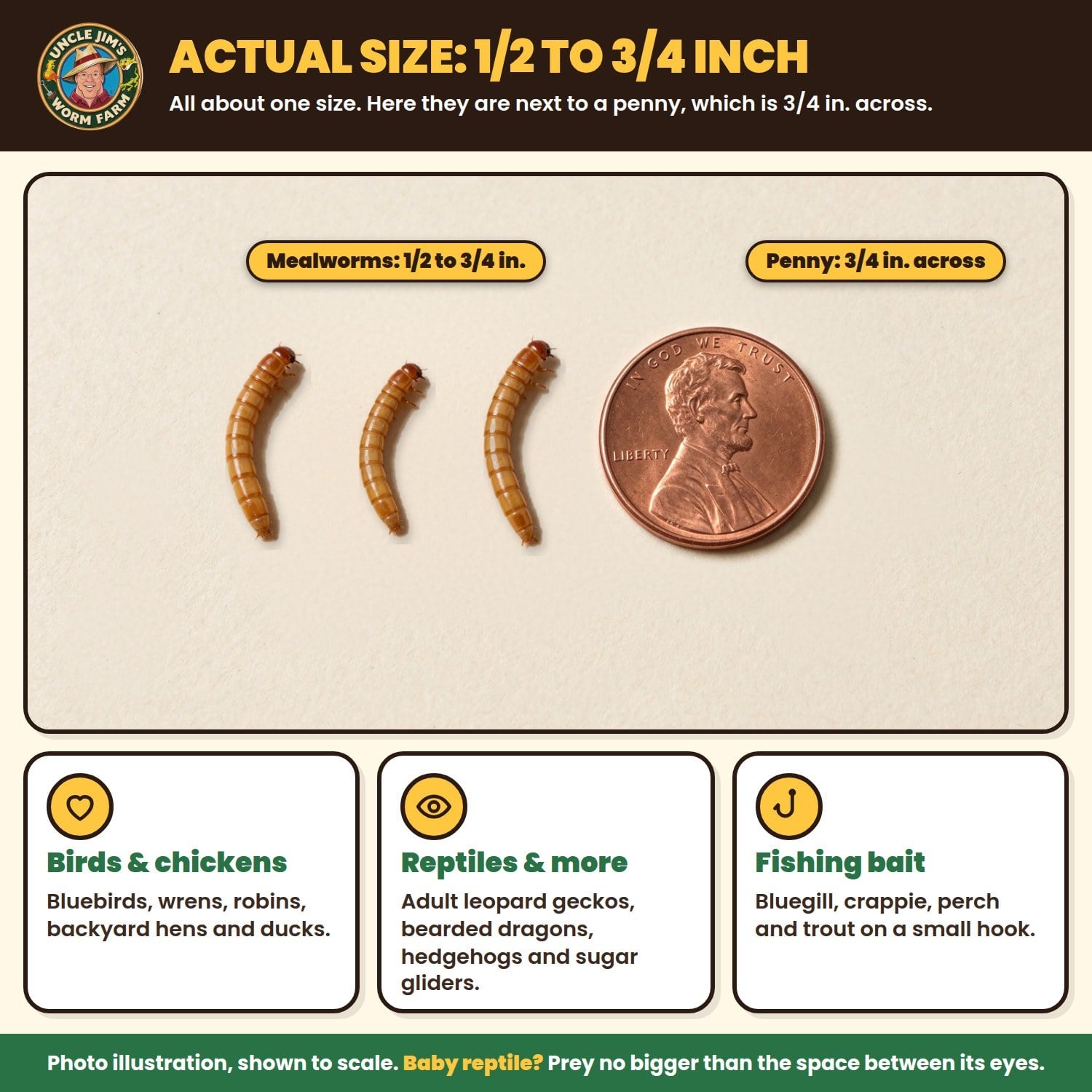
  • 1,000 LIVE MEALWORMS, ALL ABOUT ONE SIZE: 1/2 to 3/4 in. long, about the width of a penny. Regular mealworms, not giant mealworms or superworms
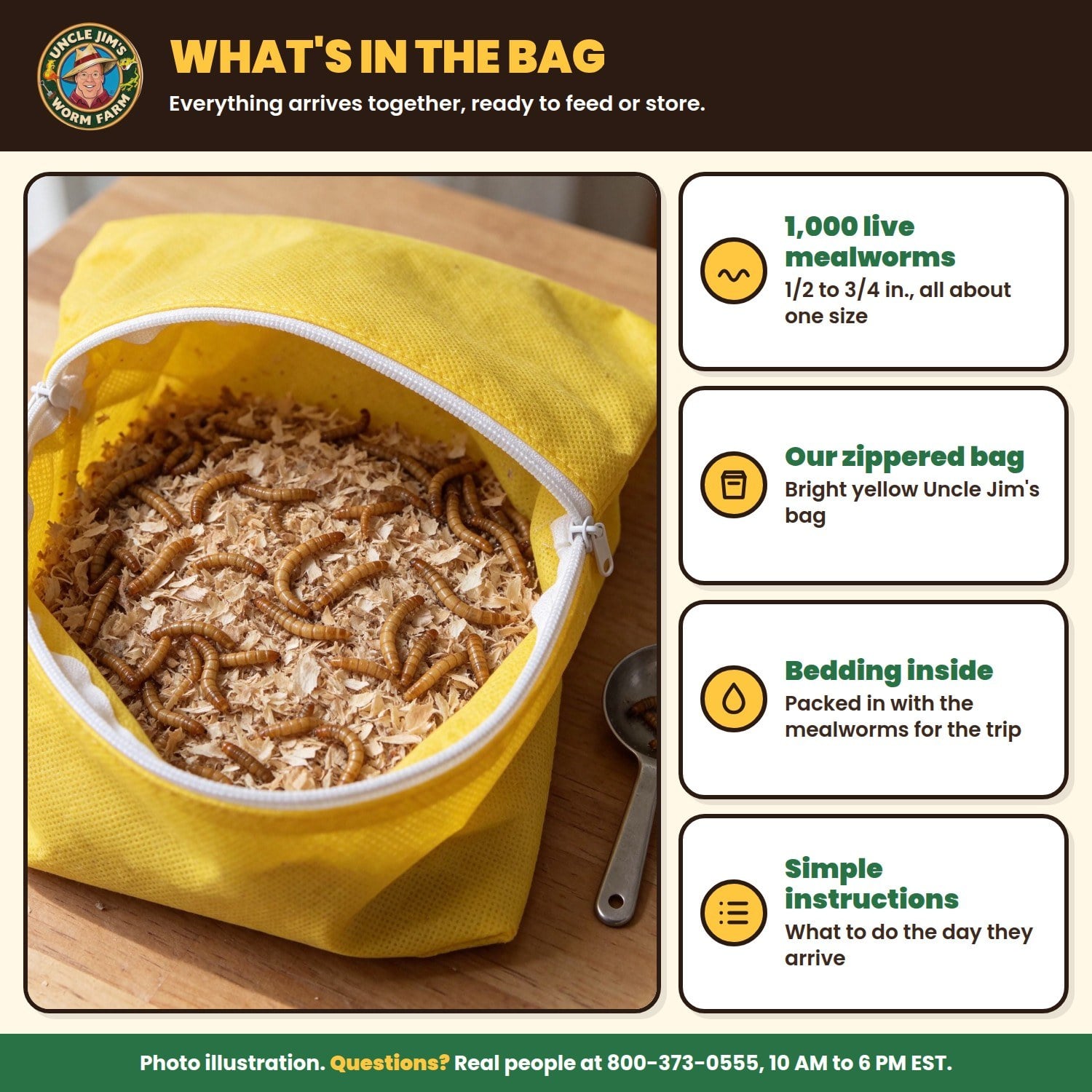
  • FREE FEDEX 2ND DAY: packed in bedding in our yellow zippered bag, 2 business days in transit
  • FOR BIRDS, FLOCKS, PETS AND BAIT: bluebirds and songbirds, backyard chickens and ducks, geckos and bearded dragons, panfish and trout
  • KEEPS FOR WEEKS: store in the fridge at about 40 to 50°F with a weekly carrot snack. Simple instructions come with every order
  • FROM A FAMILY WORM FARM SINCE 1973: real people on the phone at 800-373-0555, 10 AM to 6 PM EST
Choose purchase type

SKU: 9826 Category:

Description

Live mealworms • 1,000 count

Live, wiggly, and ready for dinner.

1,000 live mealworms, 1/2 to 3/4 in. long, packed in bedding in our yellow zippered bag, with free FedEx 2nd Day shipping.

Bluebirds swoop in for them. Hens come running. Geckos stalk them across the tank, and panfish can’t leave them alone. It’s the wiggle that gets their attention, and it’s why live mealworms are the treat almost every backyard critter goes for.

1,000
live mealworms
1/2-3/4 in.
all about one size
Free
FedEx 2nd Day
24 hrs
to send a photo if there’s a problem
  • ✓Arrive live, or send us a photo within 24 hours and we replace or refund
  • ✓All about one size, 1/2 to 3/4 in., so you know exactly what you’re getting
  • ✓Keeps for weeks in the fridge with a weekly carrot snack
  • ✓For bluebirds, chickens, reptiles, and fishing bait

Choose your count

500 to 10,000 count, all the same mealworms. Questions? Real people are here 10 AM to 6 PM EST at 800-373-0555.

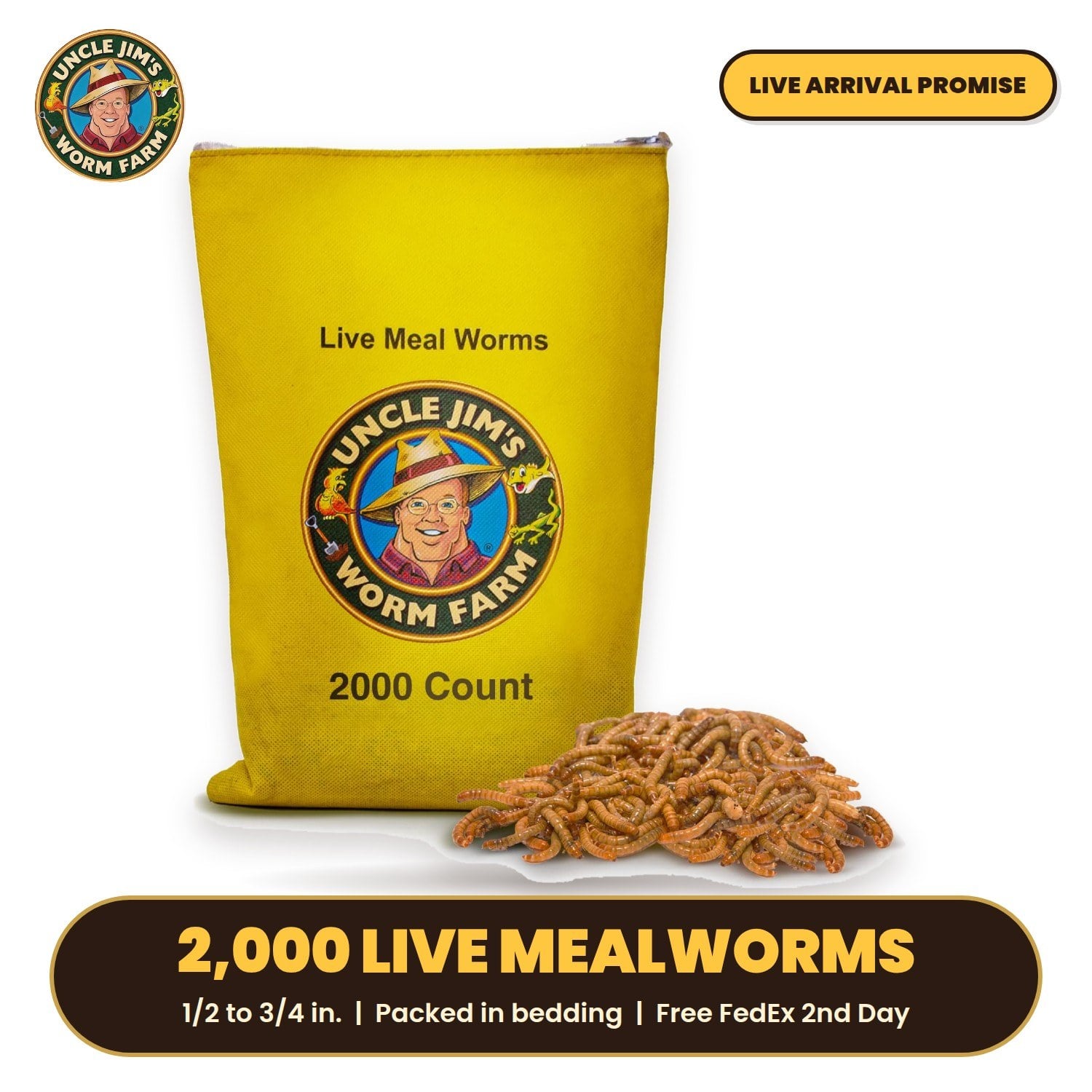
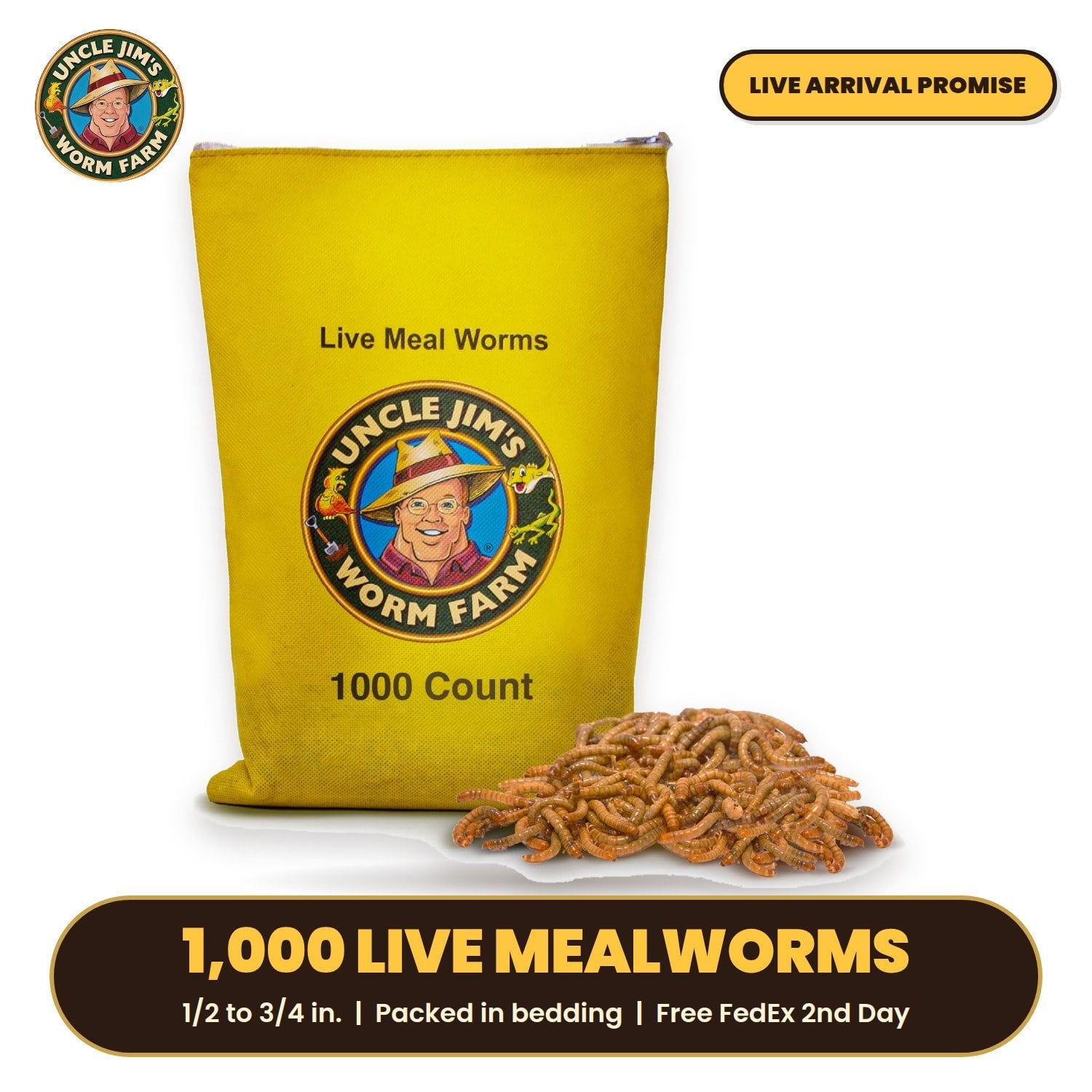
Uncle Jim's Worm Farm yellow zippered Live Meal Worms bag, 1000 Count, with a pile of live mealworms in front of it
Our real bag. 1,000 live mealworms ship in it, packed in bedding.
Our live arrival promise

Live worms, plain promise.

Live animals ride on a truck, so once in a while something goes wrong. Here is exactly how we make it right.
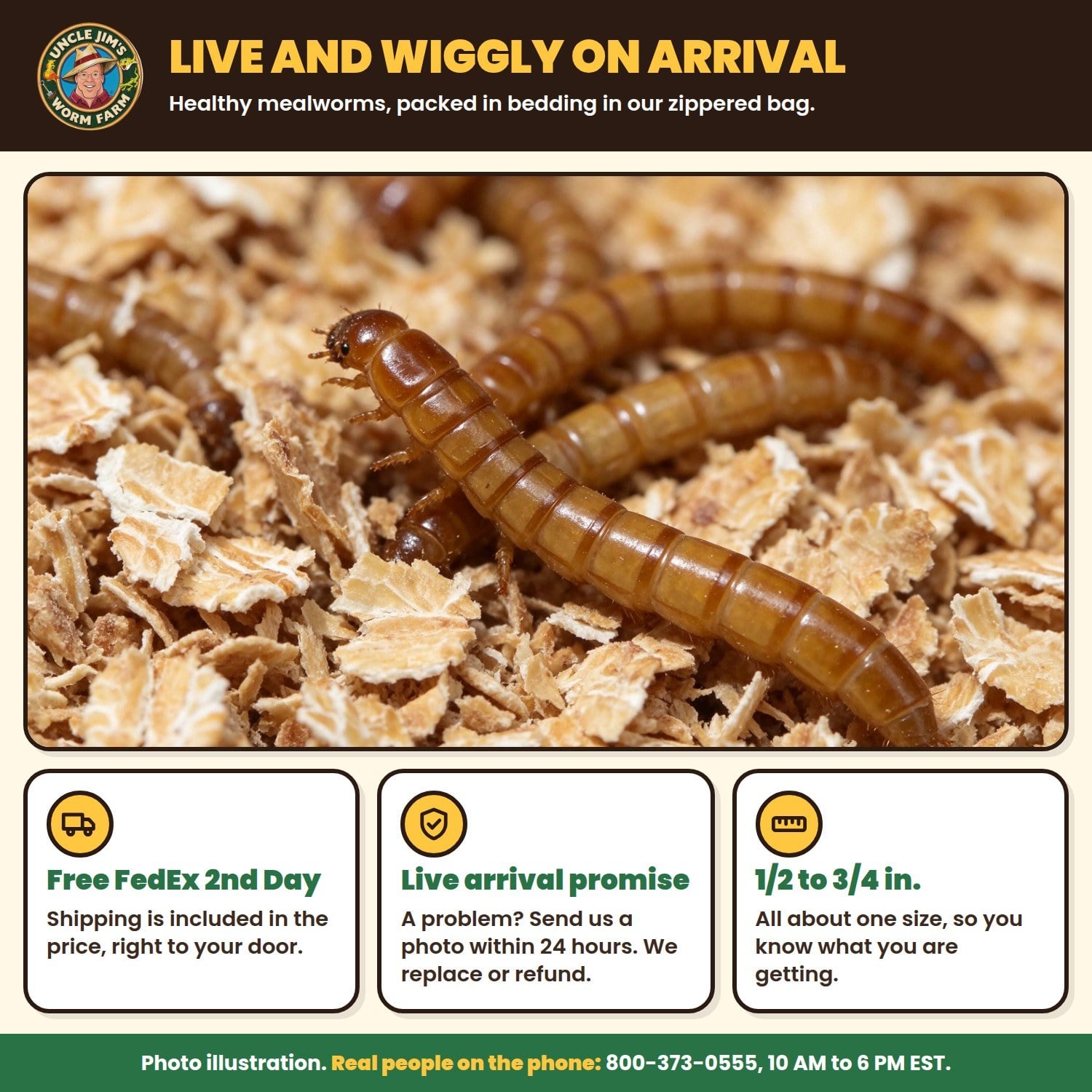
Close-up of live mealworms crawling through bedding, with three notes: free FedEx 2nd Day, live arrival promise, and 1/2 to 3/4 inch size
Photo illustration.
Live arrival promise

A problem? Send us a photo.

If your mealworms arrive dead, contact us within 24 hours of delivery with a photo, and we’ll send a replacement or give you a refund. Call 800-373-0555, 10 AM to 6 PM EST. You’ll talk to a real person at our family farm.

Cold worms look sleepy. If they arrive chilly and still, let the bag sit at room temperature for about an hour. They often perk right up.

Free FedEx 2nd Day

Shipping is included in the price. FedEx 2nd Day is 2 business days in transit.

Packed for the trip

Our bright yellow zippered bag, packed in bedding, so they have something to burrow in on the way.

Ship-day timing

Thursday and Friday orders usually arrive the following Monday. Weekend orders ship Monday. Shipping policy

Three live mealworms 1/2 to 3/4 inch long lying next to a US penny, which is 3/4 inch across, shown to scale
Photo illustration, shown to scale.
Actual size

All about one size: 1/2 to 3/4 inch.

No guessing. Every bag is the same: mealworms about 1/2 to 3/4 inch long, close to the width of a penny. They’re regular mealworms (Tenebrio molitor), not giant mealworms and not superworms.

Just right for
Bluebirds and songbirds, chickens and ducks, adult leopard geckos and bearded dragons, and a small fishing hook.
Too big for
Baby reptiles and tiny frogs. A good rule: prey no bigger than the space between your pet’s eyes.
An open yellow zippered Uncle Jim's bag full of live mealworms in bedding, with a list: 1,000 live mealworms, our zippered bag, bedding inside, and simple instructions
Photo illustration.
What’s in the bag

Everything arrives together.

1,000 live mealworms, packed in bedding in our bright yellow zippered Uncle Jim’s bag, with simple instructions. Keep them in the bedding. It gives them a place to burrow on the trip and in your fridge.

Real video from Uncle Jim’s Worm Farm. Under 2 minutes.
Watch Jim pack an order

See what shows up at your door.

No illustrations here. Uncle Jim shows you how we pack your mealworms, the same way yours will arrive.

  • ✓Our bright yellow, breathable zippered bag
  • ✓The bedding going in, then the mealworms
  • ✓A big handful of live, wiggly worms up close
Feeding guide

Who’s eating tonight?

Mealworms are a treat, or one part of a varied diet, not the whole menu. Here is how to serve them.
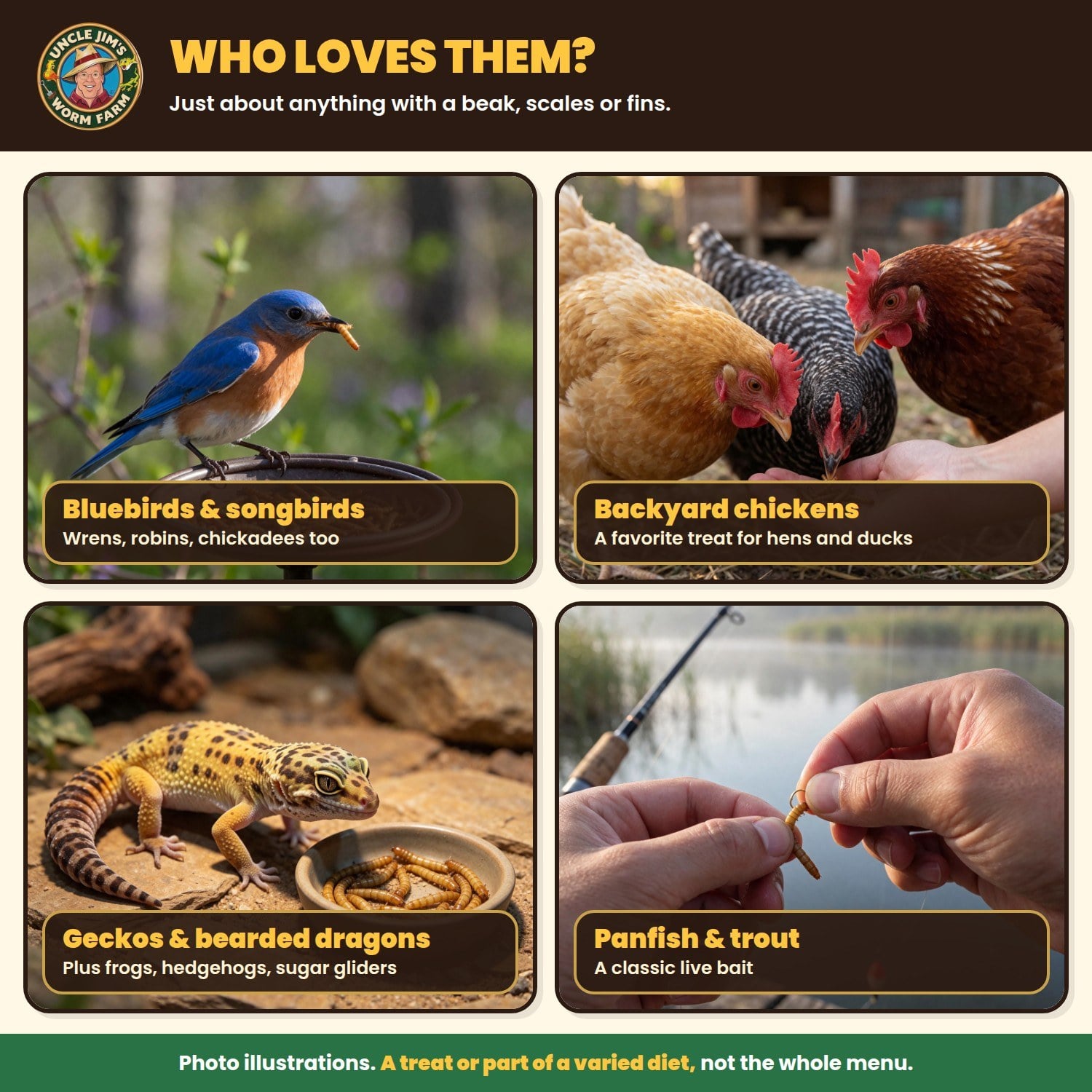
Four photos: a bluebird holding a mealworm, chickens eating mealworms from a hand, a leopard gecko beside a dish of mealworms, and a mealworm on a fishing hook
Photo illustrations.
The fan club

Beaks, scales, and fins.

Wild birds, backyard flocks, reptiles and small pets, and the fish at the end of your line. Live mealworms move, and that movement is what catches their eye.

  • ✓Bluebirds, wrens, robins, chickadees, nuthatches, and titmice
  • ✓Backyard chickens and ducks
  • ✓Leopard geckos, bearded dragons, frogs, hedgehogs, and sugar gliders
  • ✓Bluegill, crappie, perch, and trout
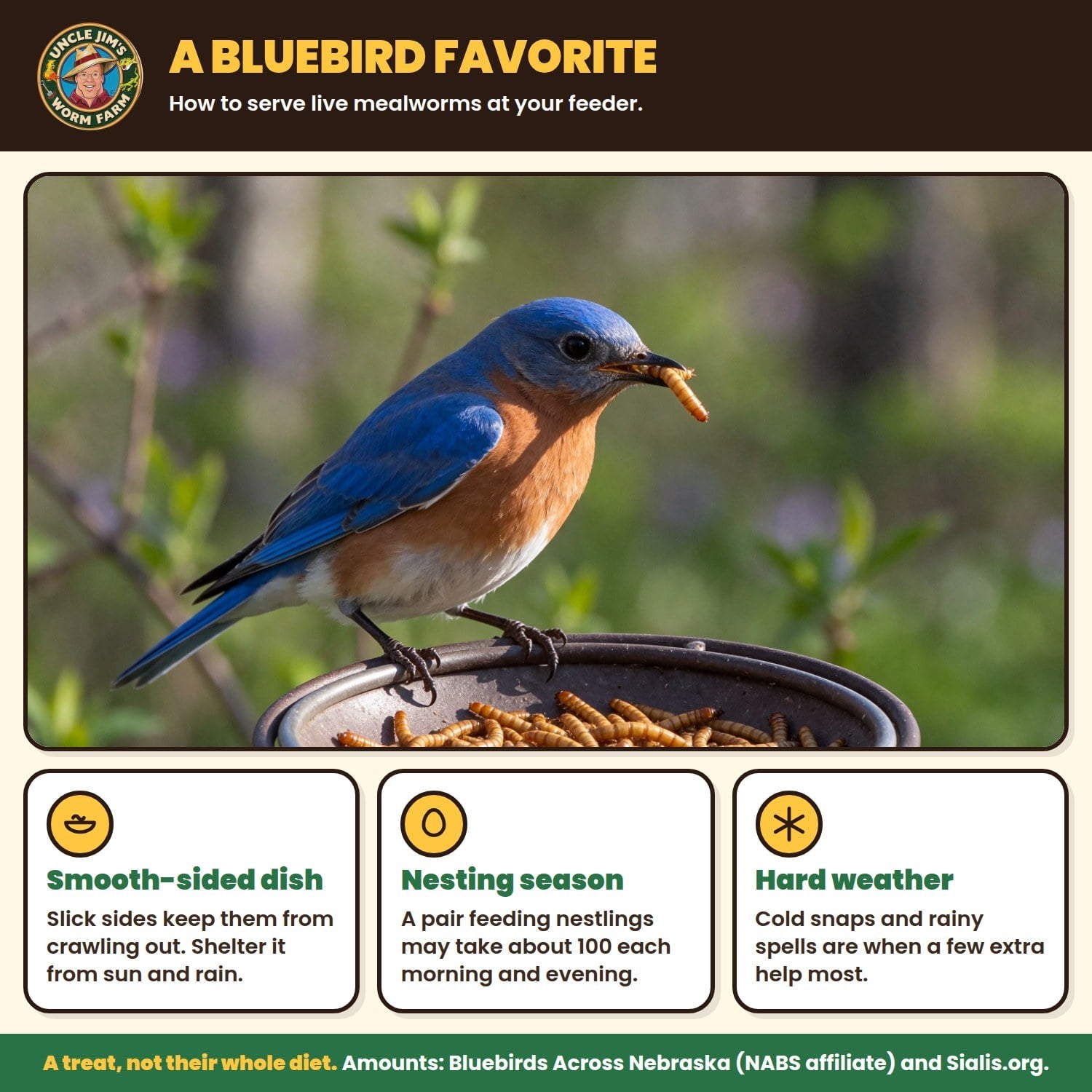
An Eastern bluebird perched on a smooth-sided dish of live mealworms, holding one in its beak, with three tips: smooth-sided dish, nesting season, and hard weather
Photo illustration.
Bluebirds & songbirds

Bring the bluebirds in close.

Serve them in a smooth-sided dish so they can’t crawl out, and keep it out of hot sun and rain. Never put food inside a nest box. Start with a few at the same time each day, and the birds learn the routine.
Everyday treat
Up to about 15 per adult bird a day, per Sialis.org.
Nesting season
A pair feeding nestlings may take about 100 each morning and evening, per Bluebirds Across Nebraska, a NABS affiliate.
Hard weather
Cold snaps and long rainy spells, when bugs are hard to find, are when a few extra help most.
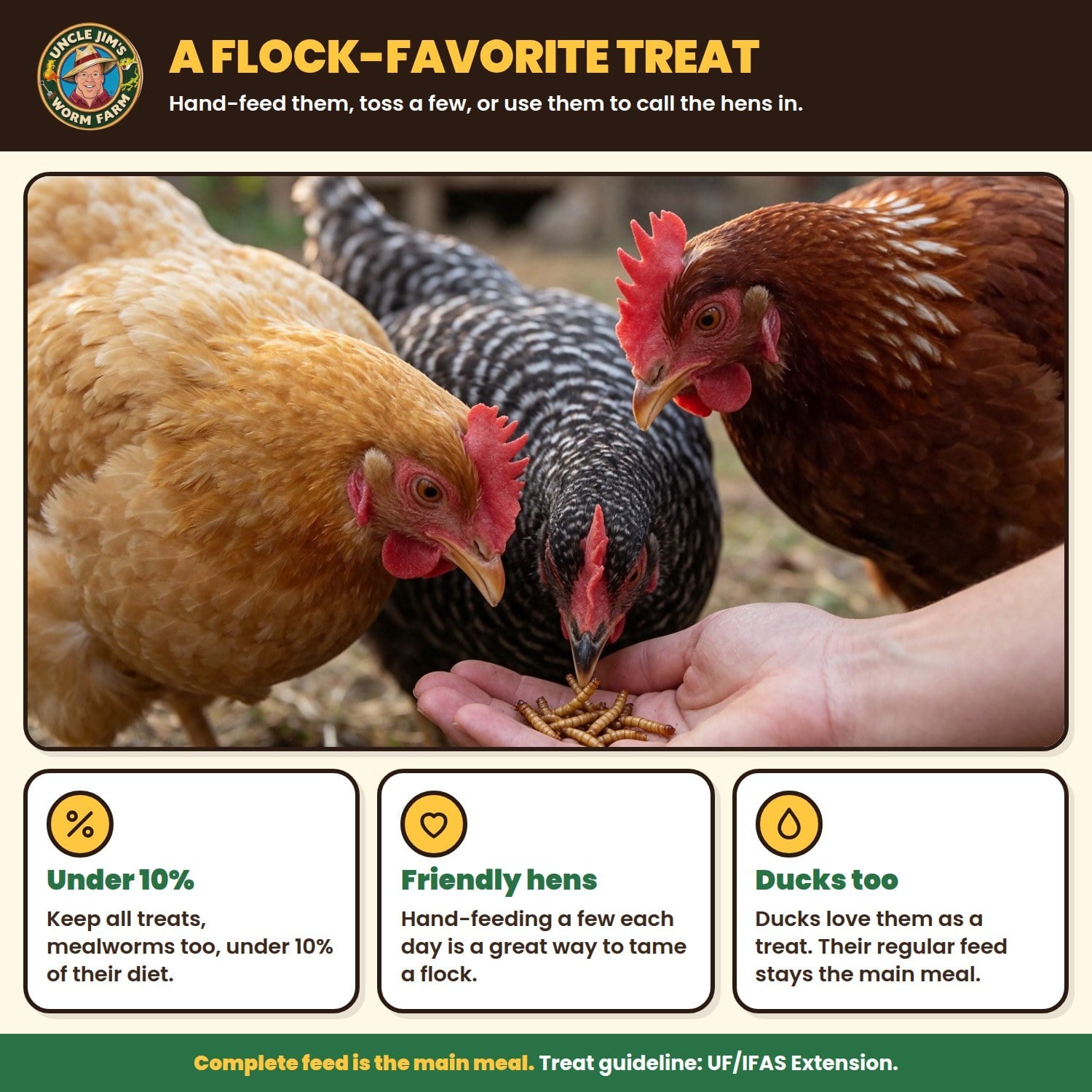
Three backyard hens eating live mealworms from an open hand, with three tips: keep treats under 10%, hand-feed to tame a flock, and ducks love them too
Photo illustration.
Backyard chickens

The fastest way to make friends with a hen.

Shake the bag and watch them come running. Hand-feeding a few is a great way to tame a flock or call them back to the run. Just keep them a treat: UF/IFAS Extension says all treats, mealworms included, should stay under 10% of what your birds eat, with complete feed as the main meal.

Ducks too: they love them, and the same rule applies. Complete feed first, treats second.
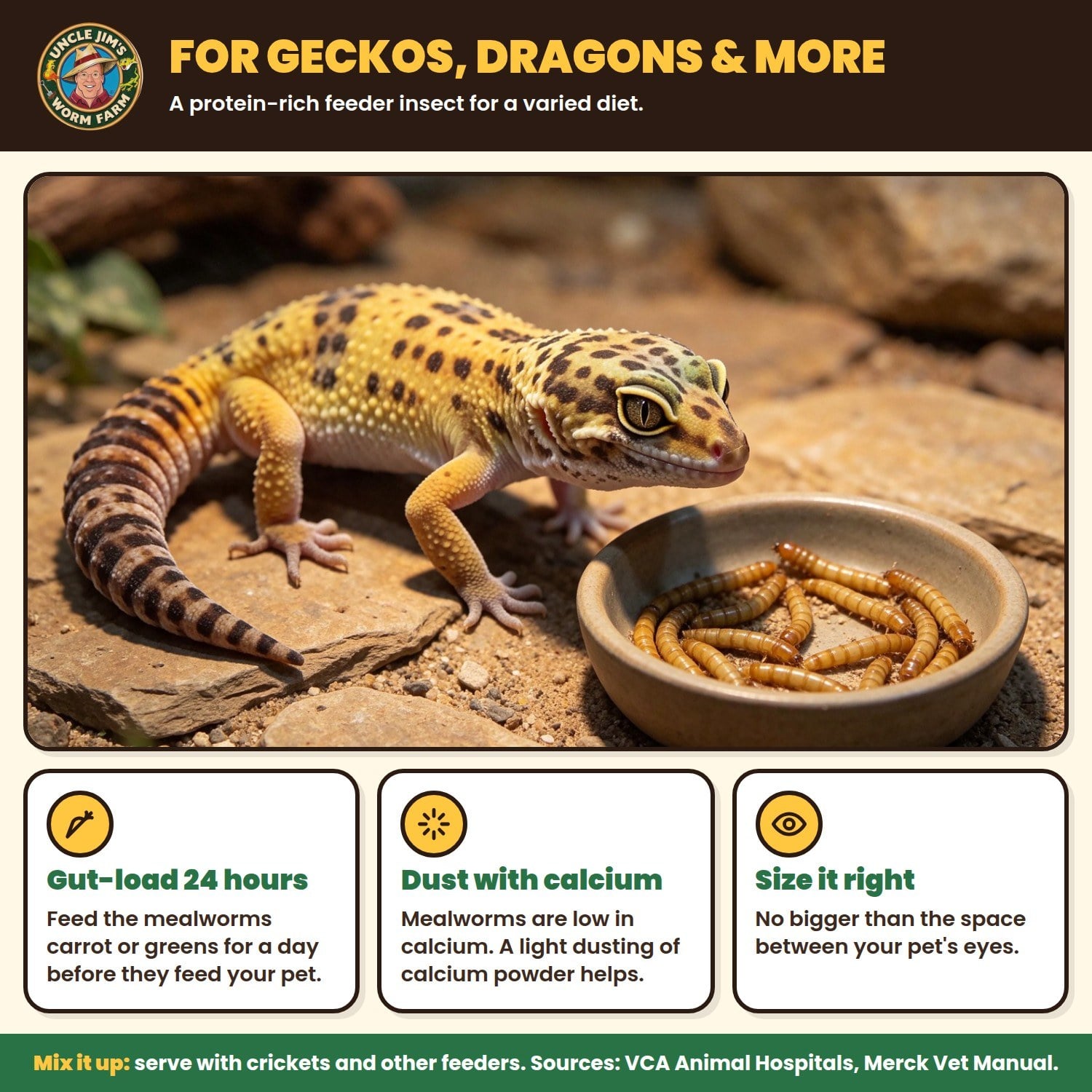
A leopard gecko next to a shallow dish of live mealworms, with three tips: gut-load 24 hours, dust with calcium, and size it right
Photo illustration.
Reptiles & small pets

A feeder insect with a wiggle.

Leopard geckos, bearded dragons, frogs, hedgehogs and sugar gliders can all have mealworms as part of a varied diet. VCA Animal Hospitals suggests leopard geckos get crickets along with smaller numbers of mealworms.
Gut-load first
Feed the mealworms carrot or greens for at least 24 hours before they go to your pet.
Dust with calcium
Mealworms are low in calcium for their phosphorus (Merck Vet Manual). A light dusting of calcium powder helps.
Size it right
No bigger than the space between your pet’s eyes. At 1/2 to 3/4 in., these suit adults better than babies.
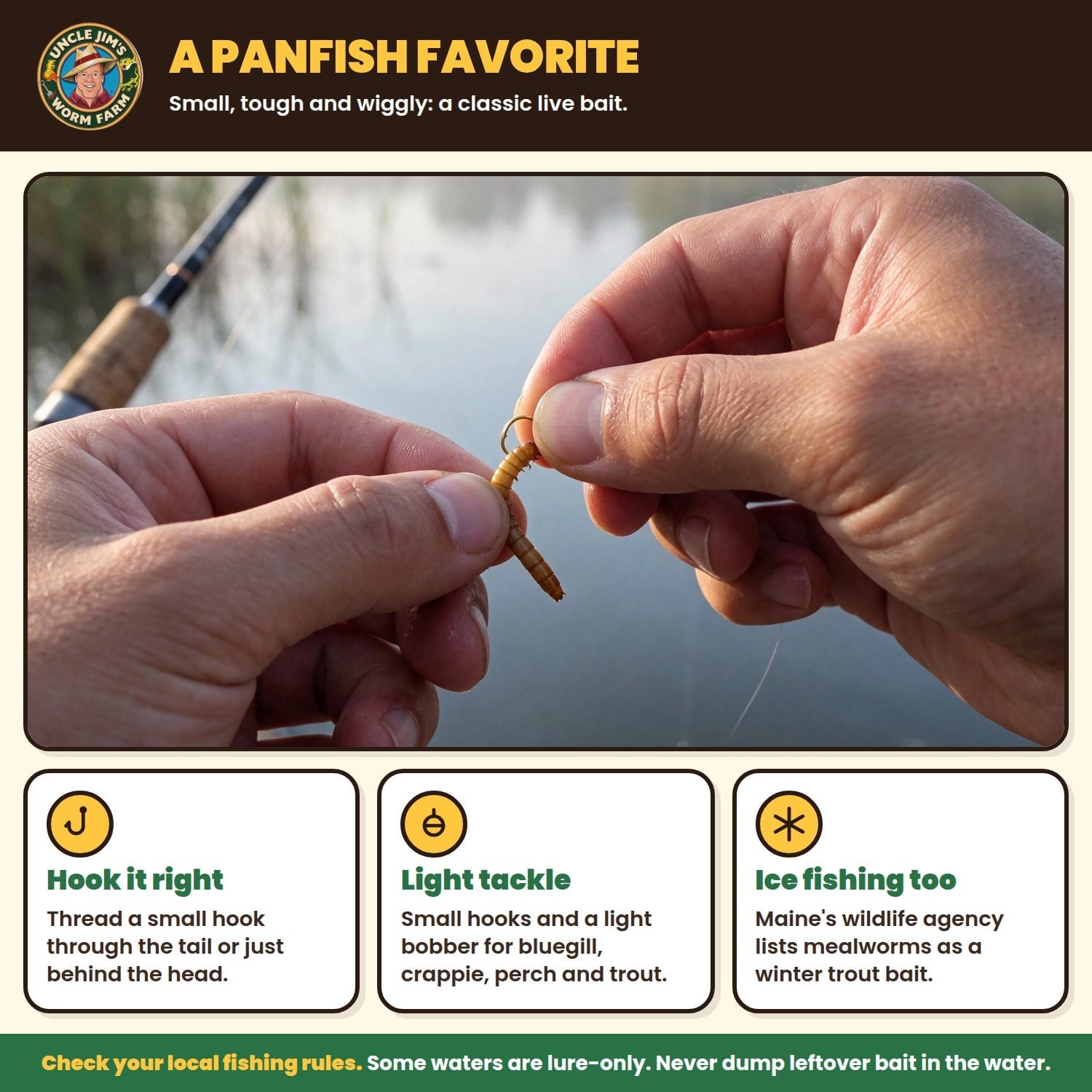
Hands threading a live mealworm onto a small fishing hook beside a lake, with three tips: hook it right, light tackle, and ice fishing
Photo illustration.
Fishing bait

Small hook. Light line. Big fun.

Bluegill, crappie, perch and trout all go for a wiggling mealworm. Thread a small hook through the tail or just behind the head, add a light bobber, and you’re fishing. Maine’s wildlife agency even lists mealworms as a winter bait for rainbow trout through the ice.

Check your local rules. Some waters are lure-only, and leftover bait goes home with you, not in the lake.

When they arrive

Five minutes now keeps them fresh for weeks.
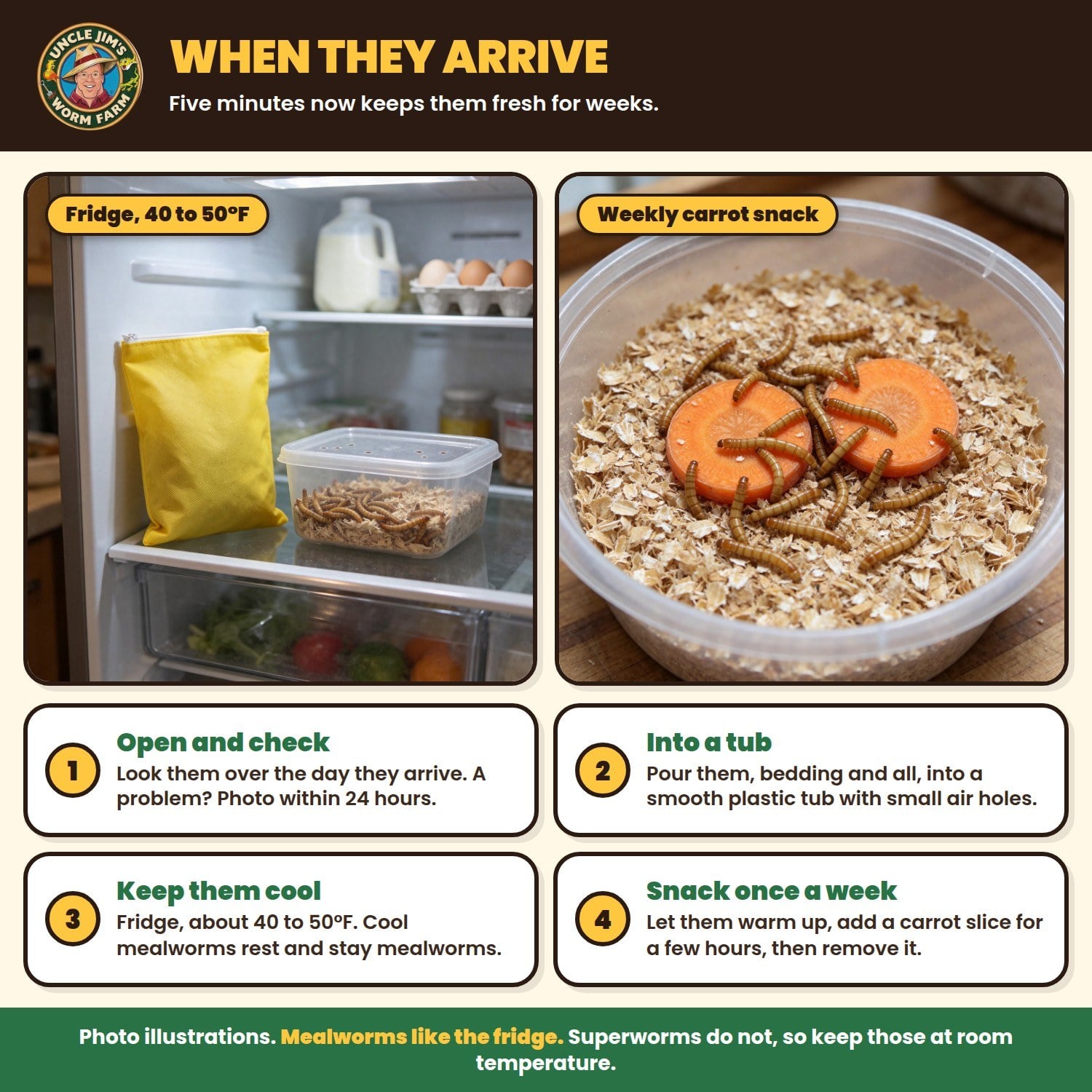
Cool mealworms rest, eat very little, and stay mealworms. Here is the whole routine.
A yellow mealworm bag and a plastic tub of mealworms on a fridge shelf, and a tub of mealworms eating carrot slices, with four steps: open and check, into a tub, keep them cool at 40 to 50 degrees F, and a weekly snack
Photo illustrations.
1

Open and check

Open the bag the day they arrive. A problem? Send us a photo within 24 hours, or call 800-373-0555.

2

Into a tub

Pour them, bedding and all, into a smooth-sided plastic tub with a few small air holes in the lid. Or keep them in the bag.

3

Into the fridge

Keep them at about 40 to 50°F. A cheap fridge thermometer takes the guesswork out.

4

A weekly snack

Once a week, let them warm up for an hour or two, and add a slice of carrot, potato, or apple for a few hours.

5

Clean up

Take out leftover veggies before they go back in the fridge, so the bedding stays dry.

How long do they last? In a busy home fridge, plan to use them within a few weeks. Kept steady around 45°F with a weekly snack, many folks keep them going for a couple of months.

Superworms are different. They are a bigger, different species and should never go in the fridge. Mealworms are the ones that do.
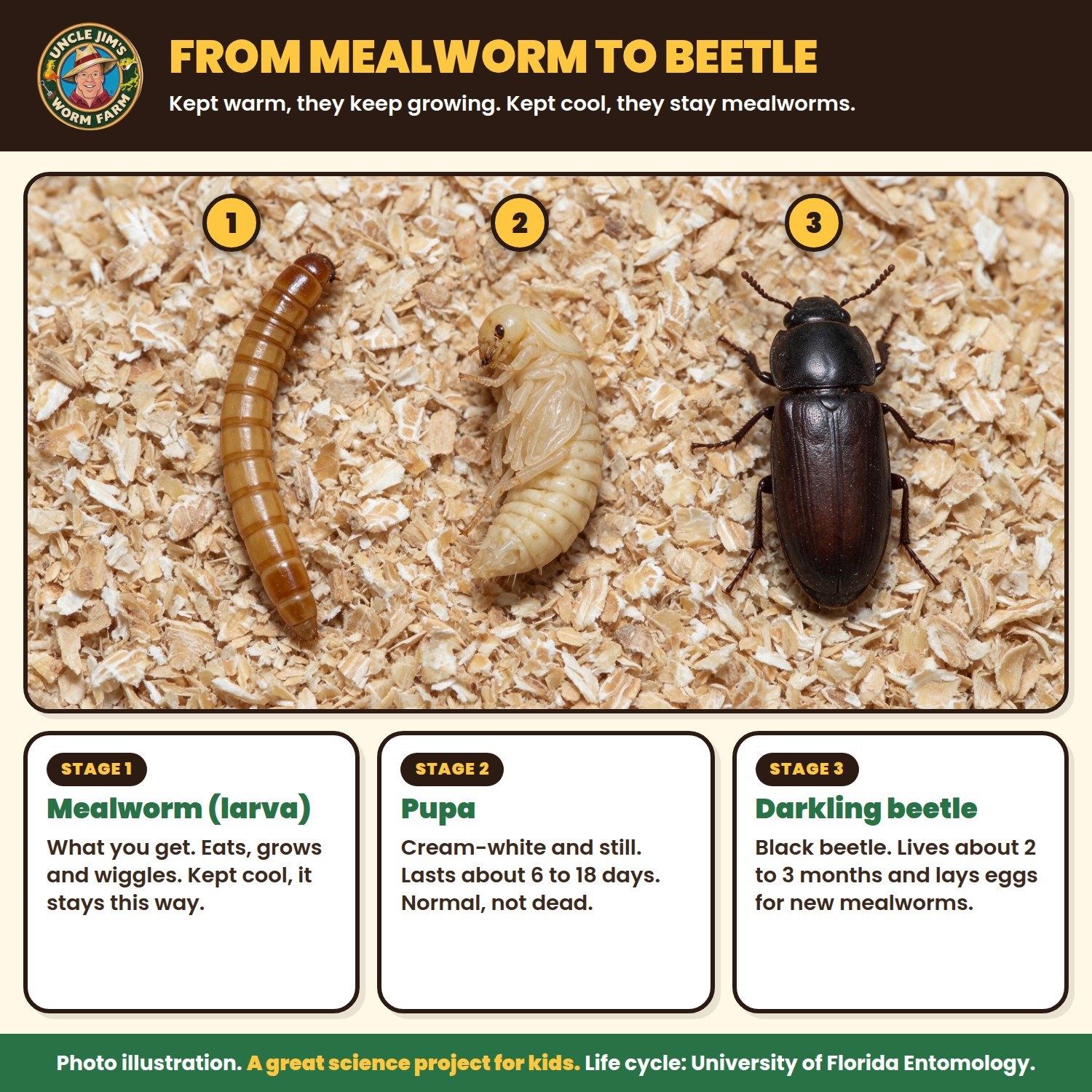
Three stages side by side on bedding: a golden mealworm larva, a cream-white pupa, and a black darkling beetle
Photo illustration.
Fun to watch

Leave a few out and watch them change.

Mealworms are the larva stage of the darkling beetle. Kept at room temperature, some turn into cream-white pupae, then black beetles, which lay eggs for the next batch. It’s a great science project for kids, and it’s how folks start their own colony. The University of Florida has the full story.

  • ✓Pupa: about 6 to 18 days. Still and pale, but not dead
  • ✓Beetle: lives about 2 to 3 months and lays eggs
  • ✓Warm speeds it up. The fridge slows it way down
How we stack up

Read the fine print on live worms.

Every seller handles shipping and dead-on-arrival claims differently. Here is ours, in plain words.
Uncle Jim’s Many online sellers
Shipping ✓ Free FedEx 2nd Day, included in the price Paid overnight shipping added at checkout
If they arrive dead ✓ Photo within 24 hours: we replace or refund Often tied to paid overnight, weather limits, or claim fees
Size ✓ Stated plainly: 1/2 to 3/4 in., all about one size “Medium” can mean 1/2 in. at one shop and 1 in. at the next
Help ✓ Real people at 800-373-0555 An email form

Pet store math

Those little cups of 50 add up fast. One bag of 1,000 is twenty cups’ worth, delivered to your door.

Fair is fair

Mealworms are a great treat and a handy feeder, but they aren’t a complete diet for any animal. They’re high in protein and fat and low in calcium (Feedipedia). That’s why birds get them as a treat, and reptiles get them after you gut-load them for a day and dust them with calcium.

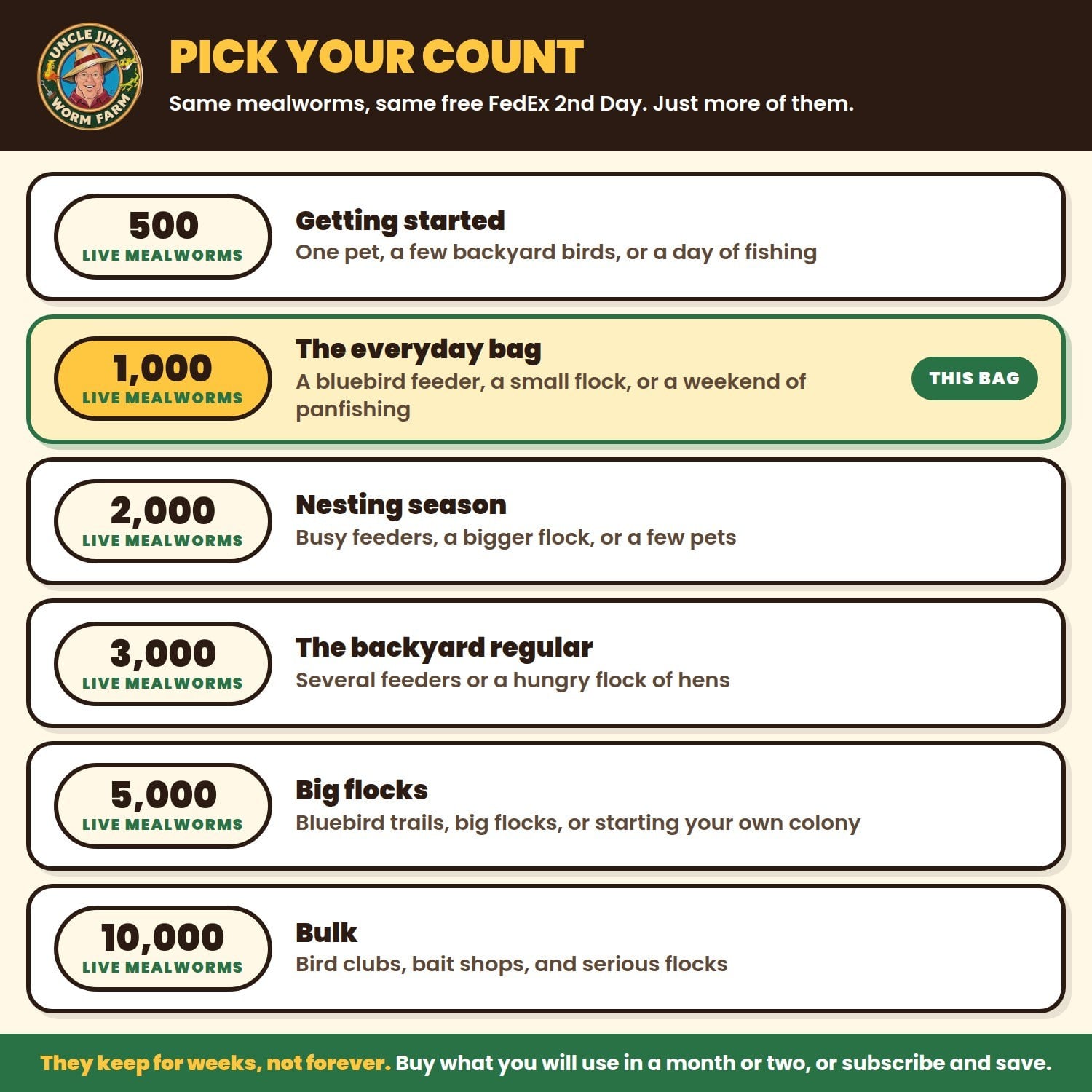
A count chart from 500 to 10,000 live mealworms with who each size is for, with the 1,000 count highlighted as this bag
Pick your count

Same mealworms. Just more of them.

Every count is the same 1/2 to 3/4 in. mealworms with the same free FedEx 2nd Day. They keep for weeks, not forever, so buy what you’ll use in a month or two.

500
Getting started
One pet, a few backyard birds, or a day of fishing. See 500 count
1,000
The everyday bag (this one)
A bluebird feeder, a small flock, or a weekend of panfishing.
2,000
Nesting season
Busy feeders, a bigger flock, or a few pets. See 2,000 count
3,000
The backyard regular
Several feeders or a hungry flock of hens. See 3,000 count
5,000
Big flocks
Bluebird trails, big flocks, or starting your own colony. See 5,000 count
10,000
Bulk
Bird clubs, bait buckets, and serious flocks. See 10,000 count

Feeding all season? Pick a subscription at the top of the page, and fresh mealworms show up on a schedule, for less.

Family worm farm since 1973

From folks who raise worms.

Uncle Jim’s Worm Farm is a family business in Spring Grove, PA. We’ve been raising worms and shipping them to folks since 1973, and we’ll tell you straight what works.
  • ✓Real people on the phone, 10 AM to 6 PM EST, at 800-373-0555
  • ✓Live mealworms, dried mealworms, composting worms, and worm bins in one place
  • ✓Straight answers on size, storage, and feeding
The details

Live mealworm details

Everything you need to know, at a glance.
What you get
1,000 live mealworms (Tenebrio molitor larvae)
Size
About 1/2 to 3/4 in. long, all about one size
Packed
In bedding, in our yellow zippered Uncle Jim’s bag, with simple instructions
Shipping
Free FedEx 2nd Day (2 business days in transit)
Live arrival
Contact us within 24 hours of delivery with a photo, and we replace or refund
Storage
Fridge at about 40 to 50°F. Weekly warm-up and a slice of carrot, potato, or apple
Keeps
Weeks in a home fridge. Up to a couple of months with steady temps and weekly care
Good for
Bluebirds and songbirds, chickens and ducks, reptiles and small pets, fishing bait
Also comes in
500, 2,000, 3,000, 5,000, and 10,000 count
Not a complete diet
Feed as a treat or as part of a varied diet
Common questions

Mealworm questions, answered.

Tap a question to see the answer.
What size are these mealworms?+

They’re all about one size: 1/2 to 3/4 inch long, about the width of a penny. They’re regular mealworms (Tenebrio molitor), not giant mealworms and not superworms. That size suits bluebirds and songbirds, chickens, adult geckos and bearded dragons, and a small fishing hook.

How do they ship, and when will they get here?+

Free FedEx 2nd Day. That’s 2 business days in transit. They travel packed in bedding in our bright yellow zippered Uncle Jim’s bag. Orders placed on Thursday or Friday usually arrive the following Monday, and weekend orders ship on Monday. See our shipping policy for the details.

What if some arrive dead?+

Contact us within 24 hours of delivery with a photo, and we’ll replace them or refund you. Call 800-373-0555, 10 AM to 6 PM EST. Real people answer. One tip first: mealworms that arrive chilly can look still and sleepy. Let the bag sit at room temperature for an hour, and they often perk right up.

What are they packed in?+

Bedding that’s right for mealworms. Keep them in it. It gives them something to burrow in on the trip and in your fridge, and it helps keep them dry.

How do I store them?+

In the fridge, at about 40 to 50°F. Pour them, bedding and all, into a smooth-sided plastic tub with a few small air holes in the lid, or keep them in the bag. Once a week, let them warm up for an hour or two, give them a slice of carrot, potato or apple for a few hours, then take out what’s left before they go back in the fridge.

How long will they last?+

Weeks, not forever. In a busy home fridge, plan to use them within a few weeks. Kept steady around 45°F with a weekly snack, many folks keep them going for a couple of months. Buy what you’ll use in a month or two, or pick a subscription so fresh ones keep coming.

Can I keep them at room temperature instead?+

Yes, but they’ll eat more, grow, and start turning into pupae and beetles sooner. Room temperature is great if you want to raise your own. For feeding, the fridge keeps them as mealworms longer.

How many mealworms should I feed bluebirds?+

As a treat, Sialis.org suggests up to about 15 per adult bird a day. When a pair is feeding nestlings, Bluebirds Across Nebraska (a NABS affiliate) puts it at about 100 each morning and evening. Serve them in a smooth-sided dish so they can’t crawl out, keep it out of hot sun and rain, and never put food inside a nest box.

Can I feed them to my chickens?+

Absolutely. Hens love them, and hand-feeding a few is a great way to tame a flock. Keep them a treat: UF/IFAS Extension says all treats, mealworms included, should stay under 10% of what your birds eat, with complete feed as the main meal. Ducks love them too, and the same rule applies.

Are they good for leopard geckos and bearded dragons?+

Yes, as part of a varied diet. VCA Animal Hospitals suggests leopard geckos get crickets along with smaller numbers of mealworms. Gut-load the mealworms for at least 24 hours with carrot or greens, and dust them lightly with calcium. Mealworms are low in calcium for their phosphorus, according to the Merck Veterinary Manual. Pick prey no bigger than the space between your pet’s eyes.

Can I use them for fishing bait?+

They’re a classic. Bluegill, crappie, perch and trout all go for them. Thread a small hook through the tail or just behind the head and fish them under a light bobber. Maine’s wildlife agency even lists mealworms as a winter trout bait for ice fishing. Check your local rules first, since some waters are lure-only, and take leftover bait home.

Why are some of them white?+

Mealworms shed their skin as they grow. A freshly molted mealworm is soft and white for a little while, then darkens back up. A curled, cream-white one that barely moves is a pupa, the next stage. Both are normal.

I found black beetles. Is something wrong?+

Nope. Those are darkling beetles, the adult stage of the mealworm. Kept warm, some mealworms turn into pupae and then beetles. Keeping them in the fridge slows that way down. Got beetles? You’ve got the start of your own mealworm colony.

Live or dried mealworms: which should I get?+

Live mealworms wiggle, and that movement is what catches a bird’s or a reptile’s eye. Dried mealworms keep at room temperature and are handy to have around. Lots of folks use both. We carry dried mealworms too.

Which count should I buy?+

Buy what you’ll use in a month or two. 500 is good for one pet or a few birds. 1,000 covers a bluebird feeder or a small flock. 2,000 to 3,000 suits nesting season or a bigger flock. 5,000 and 10,000 are for bluebird trails, big flocks and bait buckets. Every count is the same mealworms with the same free FedEx 2nd Day.

Stock up

Feeding a crowd?

More mealworms, plus dried mealworms to keep on the shelf.
Nesting season

2,000 Live Mealworms

Twice the mealworms for busy feeders, bigger flocks, or a few pets. Same size, same free FedEx 2nd Day.

See 2,000 count →

Big flocks

5,000 Live Mealworms

For bluebird trails, big flocks, or starting your own mealworm colony.

See 5,000 count →

Shelf backup

2 lb Dried Mealworms

Keeps at room temperature. Handy between live orders, or mixed in with seed.

Shop dried mealworms →

Bulk dried

5 lb Dried Mealworms

A big bag of dried mealworms for flocks and feeders that go through a lot.

See 5 lb dried →

Since 1973

A family worm farm in Spring Grove, PA, shipping worms for over 50 years

Live help

Real people 10 AM to 6 PM EST at 800-373-0555

Free 2nd Day

FedEx 2nd Day, included in the price. Shipping policy

4.4 out of 5

From 4,100+ Amazon ratings of our live mealworms (November 2026)

1,000 live mealworms • 1/2 to 3/4 in.

Somebody in your backyard is hungry.

Pick your count, and we’ll get them wiggling your way with free FedEx 2nd Day.

Choose your count

Uncle Jim’s Worm Farm has been shipping worms since 1973. Questions? Call 800-373-0555.

Uncle Jim's Worm Farm yellow Live Meal Worms bag, 1000 Count, with live mealworms

Additional information

Weight 1 lbs

Got Mealworm Questions? We’ve Got Answers!

What size are these mealworms?

They’re all about one size: 1/2 to 3/4 inch long, about the width of a penny. They’re regular mealworms (Tenebrio molitor), not giant mealworms and not superworms. That size suits bluebirds and songbirds, chickens, adult geckos and bearded dragons, and a small fishing hook.

How do they ship, and when will they get here?

Free FedEx 2nd Day. That’s 2 business days in transit. They travel packed in bedding in our bright yellow zippered Uncle Jim’s bag. Orders placed on Thursday or Friday usually arrive the following Monday, and weekend orders ship on Monday. See our shipping policy for the details.

What if some arrive dead?

Contact us within 24 hours of delivery with a photo, and we’ll replace them or refund you. Call 800-373-0555, 10 AM to 6 PM EST. Real people answer. One tip first: mealworms that arrive chilly can look still and sleepy. Let the bag sit at room temperature for an hour, and they often perk right up.

What are they packed in?

Bedding that’s right for mealworms. Keep them in it. It gives them something to burrow in on the trip and in your fridge, and it helps keep them dry.

How do I store them?

In the fridge, at about 40 to 50°F. Pour them, bedding and all, into a smooth-sided plastic tub with a few small air holes in the lid, or keep them in the bag. Once a week, let them warm up for an hour or two, give them a slice of carrot, potato or apple for a few hours, then take out what’s left before they go back in the fridge.

How long will they last?

Weeks, not forever. In a busy home fridge, plan to use them within a few weeks. Kept steady around 45°F with a weekly snack, many folks keep them going for a couple of months. Buy what you’ll use in a month or two, or pick a subscription so fresh ones keep coming.

Can I keep them at room temperature instead?

Yes, but they’ll eat more, grow, and start turning into pupae and beetles sooner. Room temperature is great if you want to raise your own. For feeding, the fridge keeps them as mealworms longer.

How many mealworms should I feed bluebirds?

As a treat, Sialis.org suggests up to about 15 per adult bird a day. When a pair is feeding nestlings, Bluebirds Across Nebraska (a NABS affiliate) puts it at about 100 each morning and evening. Serve them in a smooth-sided dish so they can’t crawl out, keep it out of hot sun and rain, and never put food inside a nest box.

Do mealworms really help nesting birds?

They can help when bugs are scarce. Cornell’s NestWatch reported a study where bluebird parents got extra mealworms, and their nestlings came out about 5.2% heavier. That’s one study, not a promise, and mealworms are a supplement, not a bird’s whole diet.

Can I feed them to my chickens?

Absolutely. Hens love them, and hand-feeding a few is a great way to tame a flock. Keep them a treat: UF/IFAS Extension says all treats, mealworms included, should stay under 10% of what your birds eat, with complete feed as the main meal. Ducks love them too, and the same rule applies.

Are they good for leopard geckos and bearded dragons?

Yes, as part of a varied diet. VCA Animal Hospitals suggests leopard geckos get crickets along with smaller numbers of mealworms. Gut-load the mealworms for at least 24 hours with carrot or greens, and dust them lightly with calcium. Mealworms are low in calcium for their phosphorus, according to the Merck Veterinary Manual. Pick prey no bigger than the space between your pet’s eyes.

What about hedgehogs, sugar gliders and frogs?

All can have mealworms in small amounts as part of a balanced diet. VCA has feeding guides for hedgehogs and sugar gliders. Your vet knows your pet best, so ask about amounts.

Can I use them for fishing bait?

They’re a classic. Bluegill, crappie, perch and trout all go for them. Thread a small hook through the tail or just behind the head and fish them under a light bobber. Maine’s wildlife agency even lists mealworms as a winter trout bait for ice fishing. Check your local rules first, since some waters are lure-only, and take leftover bait home.

Why are some of them white?

Mealworms shed their skin as they grow. A freshly molted mealworm is soft and white for a little while, then darkens back up. A curled, cream-white one that barely moves is a pupa, the next stage. Both are normal.

I found black beetles. Is something wrong?

Nope. Those are darkling beetles, the adult stage of the mealworm. Kept warm, some mealworms turn into pupae and then beetles. Keeping them in the fridge slows that way down. Got beetles? You’ve got the start of your own mealworm colony.

Can I raise my own mealworms?

Yes, and it’s a great science project for kids. Keep a few at room temperature in a tub of bedding with a slice of carrot. They’ll go from mealworm to pupa (about 6 to 18 days) to black beetle, and the beetles lay eggs for the next batch. The University of Florida has a good overview of the life cycle.

Do they smell or escape?

Kept cool and dry, they have very little smell. Wet bedding and old veggies are what usually cause odor, so take out leftovers. A smooth-sided plastic tub with a lid keeps them in, since they have a hard time climbing slick plastic.

Live or dried mealworms: which should I get?

Live mealworms wiggle, and that movement is what catches a bird’s or a reptile’s eye. Dried mealworms keep at room temperature and are handy to have around. Lots of folks use both. We carry dried mealworms too.

Are these superworms?

No. Superworms are a different, bigger species, and they shouldn’t go in the fridge. These are regular mealworms, 1/2 to 3/4 inch long, and the fridge is right where they like to be.

Which count should I buy?

Buy what you’ll use in a month or two. 500 is good for one pet or a few birds. 1,000 covers a bluebird feeder or a small flock. 2,000 to 3,000 suits nesting season or a bigger flock. 5,000 and 10,000 are for bluebird trails, big flocks and bait buckets. Every count is the same mealworms with the same free FedEx 2nd Day.